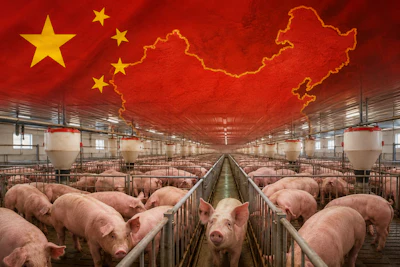
China's pig industry is losing an estimated $3.8 billion per month and faces a liquidation that could extend well beyond 2026, according to a global agricultural analyst who presented June 3 at World Pork Expo in Des Moines, Iowa.
Brett Stuart, president of Global AgriTrends, said a combination of massive overproduction and structurally weakening pork demand has pushed China's swine sector into a severe financial crisis.
"This is one of the biggest liquidations in the world going on right now due to unprofitability," Stuart said.
 Brett StuartRoy Graber
China holds close to 50% of the world's swine herd.
The crisis traces to the aftermath of African swine fever (ASF), which eliminated roughly two-thirds of China's hog herd around 2019. The swine shortage sent profits soaring to $300–$400 per head, prompting producers to rebuild at an aggressive scale — including large high-rise confinement facilities and mega-farms. The resulting overexpansion flooded the market and has kept the sector unprofitable from 2021 through the present.
But Stuart said the problem is not only one of supply. Chinese consumer demand for pork is declining, particularly among younger generations who are eating more beef, seafood and poultry. China has increased its poultry production, Stuart said, and the country has also become the world's largest beef importer — a changing trend he said “came out of nowhere.”
"Historically, those older generations in China were eating 70–80 pounds of pork per year," Stuart said. "The younger generations aren't eating as much pork."
China's population is also plateauing, with signs that it will gradually become smaller, which would cause additional reduced domestic consumption.
The Chinese government directed large-scale producers last fall to cap production and reduce sow inventories in 2026. First-quarter production data from those same operations, however, showed output increased rather than declined. Stuart said the government lacks the financial capacity to subsidize an industry losing at this scale.
"You can't pour $3 billion a month into any industry," he said.
Stuart projected the liquidation will persist through 2027 and said the financial pressure is falling equally on small farmers and large integrated producers. He said it would not surprise him to see one or more of China's large hog farming companies enter major financial distress or bankruptcy this year or in the near term.
In China, he noted, hog producers do not have the land equity or capital access that American producers often rely on when margins turn negative.
"When you can't pay the feed bill, you're getting rid of hogs," Stuart said. "And I think that's happening all over China now."