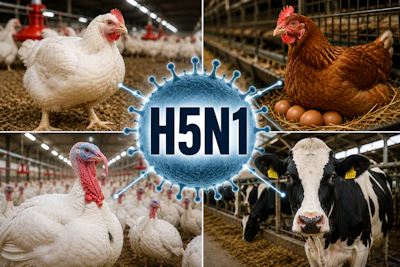
Until a few years ago, the H5N1 virus was primarily thought of as an avian disease, and the poultry industry was believed to be the only animal agriculture sector that could be severely affected by it.
However, that changed when the virus started spreading in dairy cattle in the United States in 2024. Workers at affected dairy farms also contracted the virus, commonly known as avian influenza (AI).
Those experiences with H5N1 show why the broader agriculture industry needs to embrace a One Health culture, said Cheryl Stroud, executive director of the One Health Commission (OHC).
The OHC defines One Health as an integrated, unifying approach that aims to sustainably balance and optimize the health of people, animals and ecosystems. It recognizes that the health of humans, domestic and wild animals, plants and the wider environment, including ecosystems, are closely linked and interdependent.
Speaking at the World's Poultry Congress on July 13 in Toronto, Canada, Stroud discussed the importance of One Health collaboration.
She said that in April 2024, there was a lot of alarm over dairy cattle being infected with the virus. Then some workers became infected. While all this was happening, Stroud said, farmers did not want researchers at their facilities, because if the researchers found a problem with H5N1, the farmers' operations would have to shut down, and they would suffer a financial loss.
Stroud said it is problematic that there are still so many unknowns about the virus and what it is capable of.
"We're still struggling with those questions," she said.
Stroud shared a slide that cited a paper written by some of her colleagues, stating that the situation "absolutely requires animal ag's stronger collaboration."
"The animal ag sector as a whole really needs to understand and embrace and help us with this whole thought process," she said. "We really must find new, non-threatening ways to better engage."