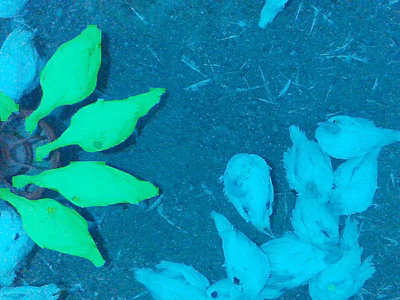
Penn State researchers developed an AI camera system that automatically estimates individual turkey body weights from overhead images, eliminating labor-intensive manual weighing while enabling producers to optimize nutrition, detect health issues, and reduce production cycle time.
- The AI system uses overhead cameras and depth imaging to estimate live turkey body weight without manual labor or scale platforms
- Cameras capture a field of view up to 3 by 4 feet, allowing monitoring of multiple birds simultaneously compared to traditional scale methods
- The deep-learning model was trained on 30 male turkeys monitored over 14 weeks (ages 37-133 days) with manual weights taken five times weekly
- High-frequency weight data helps producers identify growth delays, adjust nutrition precisely, detect disease or heat stress, and forecast delivery schedules
- Saving just 1-3 days on production cycles generates significant cost savings for commercial turkey operations
A camera-based artificial intelligence (AI) system developed at Pennsylvania State University (Penn State) could give turkey producers frequent, individualized body-weight estimates without the labor demands of manual weighing or scale platforms.
The system uses overhead cameras to estimate live turkey body weight from images, offering a higher-frequency, less labor-intensive alternative to traditional weighing methods, said Enrico Casella, assistant professor of data science for animal systems in Penn State's College of Agricultural Sciences.
Producers currently weigh only a small fraction of birds, often in averaged groups. Cameras, Casella said, capture a much larger field of view than a typical scale platform, up to roughly three by four feet.
"Cameras can provide an opportunity to remove or at least reduce the amount of labor while also getting a lot of high-frequency, individual animal body weight points," Casella said.
That high-frequency data could help producers spot flocks falling behind expected growth curves, support precision nutrition adjustments and potentially flag disease or heat stress if paired with thermal imaging. Longer term, more accurate growth forecasting could allow producers to fine-tune delivery and processing schedules, generating production-cycle savings.
"If you can save one, two, three days on your production cycle, that's a lot of money being saved," Casella said.
Building the model
Published in Frontiers of Animal Science, the study involved 30 male turkeys housed together and monitored from 37 to 133 days of age, spanning nearly 14 weeks of growth.
A camera positioned above the birds captured both standard color images and depth images, which recorded the distance between different parts of each turkey and the camera. That depth data helped reveal the three-dimensional shape and size of each bird, characteristics closely tied to body weight.
Because multiple birds often appeared in the camera's field of view at once, the AI had to be trained to distinguish which pixels belonged to which individual turkey. That task goes beyond simply detecting the presence of a turkey, Casella said, adding that the system had to identify every pixel belonging to a specific animal as opposed to the background or a neighboring bird.
To train and validate the model, researchers manually weighed the turkeys five times per week. A deep-learning neural network commonly used for image analysis learned relationships between the birds' appearance, size and shape and their corresponding body weights.
The camera-AI system's predictions of future body weight were nearly as accurate as its estimates of turkeys' current weight, a result Casella called significant.
Next step: Commercial validation
The next step is testing the system on commercial farms, where flocks are larger and less uniform than the well-managed research flocks at Penn State, Casella said.
"Having more birds with a more heterogeneous range of weights would really allow us to train the models better and ultimately see: Can we really do this?" Casella said.
He added that he is seeking research and commercial partners to help validate the system's accuracy and compare its performance against scale-based monitoring.