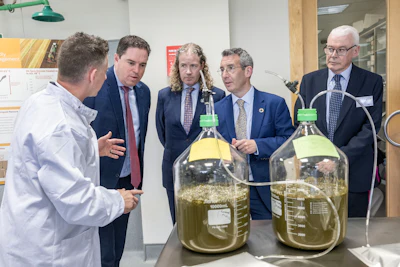
Alltech has established an expanded EU Applications Laboratory at the company’s European headquarters in Dunboyne, County Meath, Ireland. The new lab will bring together practical agricultural innovation, climate action and renewable energy research within a single applied research facility.
The facility was created to accelerate the development and validation of practical technologies for the Irish, European and global agricultural industries. The laboratory will serve as a center for applied research focused on improving nutrient efficiency, reducing environmental impact and supporting renewable energy generation from agricultural systems. It has been designed to bridge scientific research with on-farm implementation, ensuring technologies can be tested under practical operating conditions.
“From this lab in Ireland, we will advance our dedication to solving real agricultural issues and scale practical solutions to farms across more than 140 countries,” said Dr. Mark Lyons, president and CEO of Alltech. “This lab enables us not only to deliver on our promise to improve the nutrition and well-being of animals but to create new income streams such as energy generation for farmers, which further drives down the environmental impact of the farm.”
Some key areas of focus for the Alltech EU Applications Laboratory will include:
Water quality and phosphorus management
Research within the laboratory is focused on improving water quality through phosphorus reduction and nutrient management technologies for slurry and digestate systems. The work aims to support Ireland’s and Europe’s water quality objectives by developing practical slurry additive solutions capable of reducing phosphorus mobility and nutrient losses from agricultural land. This research explores mechanical, chemical and biological solutions for phosphorus removal.
The research also focuses on improving farm resource efficiency through enhanced nutrient retention and more homogenous slurry systems, supporting better nutrient utilization and more sustainable land application practices.
The laboratory also plays a central role in Alltech’s involvement in the Mid Ulster Biorefinery project, which has secured support through the Department of Agriculture, Environment and Rural Affairs (DAERA) Sustainable Utilisation of Livestock Slurries (SULS) Small Business Research Initiative (SBRI) Fund 2024-28. Working in partnership with CEMCOR, Tobermore and RSC, the project is developing innovative solutions to reduce phosphorus levels in livestock slurry, helping to improve water quality in rivers and streams that feed into Lough Neagh while supporting more sustainable nutrient management on farms.
Energy security and anaerobic digestion
A major focus of the EU Applications Laboratory is renewable energy and anaerobic digestion (AD) research, supporting Ireland’s ambitions for indigenous renewable gas production and improved energy security.
The laboratory includes:
- Biochemical methane potential (BMP) testing
- Continuous pilot-scale anaerobic digesters
- Feedstock optimization and digestate evaluation systems
- Applied research platforms for slurry and manure dominant AD plants
The lab is evaluating a wide range of agricultural feedstocks and residues, including sequential crops, agricultural residues, animal manure and biowaste. It is also developing new technologies such as synbiotics, designed specifically for slurry and manure dominant anaerobic digestion systems.
Research activities are also examining:
- Biogas optimization through synbiotics and mineral technologies
- Crop and silage evaluation for AD systems
- Digestate nutrient management
- Modeling and AD system optimization
- Integration of manure management technologies within AD plants
Manure management and emissions reduction
The laboratory has a strong focus on climate-friendly manure management technologies, including continued development work with Eminex, a methane-reducing slurry additive technology manufactured by Alzchem and distributed by Alltech.
Research is focused on:
- Methane emissions reduction from stored slurry
- Reduced ammonia, hydrogen sulfide and nitrous oxide emissions
- Improved slurry homogeneity and nutrient retention
- Reduced floating layer formation
- Improved fertilizer value of slurry and digestate
The EU Applications Laboratory is also supporting wider collaboration opportunities across the Irish agrifood, renewable energy and environmental sectors, including research related to biomethane, nutrient recovery and low-emission farming systems.