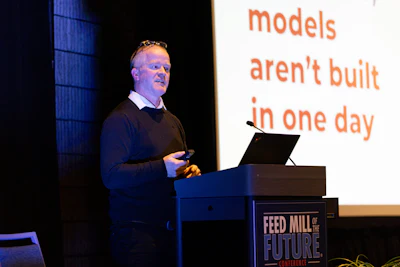
Karel Vervaet, BESTMIX's senior product specialist – nutrition, told Feed Mill of the Future Conference attendees that artificial intelligence (AI) can already develop basic recipes and prescribe ingredient processing instructions based on decades of digitally published industry data. But how accurate or useful are AI-generated formulations to feed mills today?
Vervaet said to achieve measurable results in feed formulation or process optimization with AI, it requires volumes of data, considerable investment and time — particularly in model training.
“AI models need to learn — they need to be trained,” he said. “With such an exercise, in the beginning, it will fail because it lacks information. You need a lot of information to train your model well — quality and clean data.”
Vervaet walked the audience through two AI models BESTMIX trained to demonstrate the efficiency gains possible for feed mills that are committed to gaining a competitive edge in the future.
“If you want to continue to evolve, then AI really is something that is disruptive,” Vervaet said. “You will need new tools like AI to be able to get to that next level of support in your daily work in improving efficiency, product quality and stability.”
Predicting recipe composition made easier
The first case study addressed a persistent challenge in feed formulation: the knowledge gap between experienced and junior formulators. BESTMIX developed an AI tool designed to close that gap by mining historical formulation databases to generate optimized starting recipe compositions.
A user inputs parameters — animal type, diet preferences such as GMO-free or low carbon footprint, protein source, price range and batch weight — and the model proposes a recipe tailored to those specifications.
“You don’t need experience, you don't need help from a colleague if you’re new in the business,” Vervaet said. “Here you have a perfect example of how we can help you make quality feed without extensive knowledge about nutrition.”
Vervaet said AI allows companies to leverage their veteran employees’ years of experience to not only achieve more output with newer and fewer formulators, but also with less failure.
“We foresee that this will be done in real time and embedded in the optimization, so the job of a formulator will become easier working with AI,” Vervaet said.
The tool’s potential extends to on-farm ration calculation as well, where AI could incorporate production key performance indicators (KPIs) such as milk yield alongside environmental and species-specific variables to generate real-time ration recommendations without requiring operators to navigate complex animal models or optimization algorithms.
Cutting waste in a complex process: Extrusion optimization
The second example also addressed the experience gap but focused on minimizing waste in the extrusion process. Given its complexity, the experience level of an operator can directly impact costs, Vervaet said. Variabilities in the preconditioning, extrusion, drying, cooling and coating processes can create issues that only the most senior operators may be able to solve.
“That's not something you want,” Vervaet said. “You don’t want to rely on one operator, the most experienced person in the mill, because your mill operates 24/7. The other 16 hours a day, you still need that quality outcome.”
Working with a customer on a detailed business case, BESTMIX identified three areas where AI intervention generated quantifiable savings on a single extrusion line. AI reduced startup phase losses by 10%, saving approximately EUR15,000 (US$17,300) per year. Rework reduction — cutting down on failed runs where output must be reprocessed — added another EUR150,000 annually.
The largest opportunity came from moisture over-formulation, a common practice where producers add excess margin to ensure the final product meets moisture specifications. AI reduced that over-formulation by 50%, bringing total savings across the three areas to more than EUR500,000 per extruder per year.
To deliver those results, BESTMIX built an operator-facing AI dashboard that provides real-time, specific corrective instructions. For example, it could direct an operator to reduce downpipe temperature on a given line or adjust steam input. The system also supports predictive modeling, allowing operators to simulate how parameter changes will affect moisture content before acting.
Performance benchmarks underscore the tool’s impact. In 87% of cases, the AI model outperformed even the most experienced human operators on moisture content prediction, with 50% less variability overall.
“There are so many variables that even experienced operators can no longer comprehend,” Vervaet said. “Our AI model does 50% better than the operator in terms of variability of the moisture content.”
BESTMIX’s long-term vision is a feedback loop where production AI informs formulation decisions — helping identify which ingredients perform poorly through the extruder and adjusting recipes accordingly.
Ready to start? Focus on data
The results of both these cases are significant, but Vervaet emphasized they didn’t come quickly or effortlessly.
The extrusion case study was built on a dataset from a single customer who had been logging 22 parameters on an hourly basis for four years, amounting to millions of data points. Even with that foundation, the model isn't perfected yet and is still improving.
Vervaet cautioned against expectations of quick implementation. A feed company with seven extruders might do the math and calculate EUR3.5 million in annual savings, but the infrastructure, data pipeline and model training will take time to build.
Beyond data volume, quality matters. In the formulation case, metadata including animal type, sales price, pallette size, customer and species classification must accompany historical records for models to generate reliable outputs and satisfy the business need. Initially, the BESTMIX model’s output accurately predicted just four of the 10 raw materials needed for a particular recipe.
“But once you really train the model, once you provide it enough metadata, then you can ask the right questions, and it goes up to 80% of the composition being predicted the right way,” Vervaet said.
Intellectual property protection across companies also limits the industry's ability to pool data at scale, and standardization across diverse feed operations remains a challenge BESTMIX is still working to address.
Vervaet stressed that, throughout the process of implementing AI in formulation and mill optimization, human judgment remains essential. He cautioned that AI still can and will make mistakes.
“AI can be smart, but incredibly stupid at the same time — it’s only as smart as the data it has been provided,” he said.