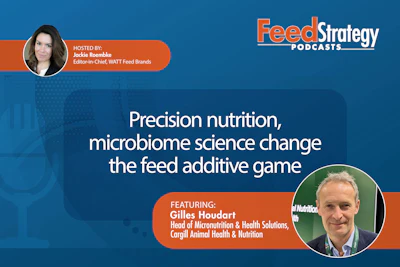
The science behind feed additives has never moved faster — and neither has the strategic landscape surrounding them. From AI-powered compound discovery to the integration of postbiotic and phytogenic technologies, companies like Cargill Animal Nutrition and Health are operating at the intersection of deep nutrition science, shifting producer demands and an evolving regulatory environment.
At the 2026 International Processing and Production Expo (IPPE) in Atlanta, Feed Strategy Podcast caught up with Gilles Houdart, global head of Micronutrition and Health Solutions at Cargill Animal Nutrition and Health, for a wide-ranging conversation about where the feed additive industry is headed — and how Cargill is positioning itself to lead the way.
Transcript of interview with Gilles Houdart, global head of Micronutrition & Health Solutions, Cargill
Jackie Roembke, editor-in-chief, Feed Strategy: Hi everyone. Welcome to Feed Strategy Podcast. I'm your host Jackie Roembke, editor-in-chief of WATT Feed Brands. This edition of Feed Strategy Podcast is being brought to you by FeedStrategy.com. FeedStrategy.com is your source for the latest news and leading-edge analysis of the global animal feed industry.
While at the 2026 edition of the International Processing and Production Expo (IPPE) held in Atlanta, Georgia, January 27 through 29, I had the opportunity to catch up with Gilles Houdart, global head of Micronutrition and Health Solution at Cargill Animal Nutrition and Health.
During my visit to the Cargill booth, we had the chance to discuss some of the pressing issues affecting the feed industry, and how those will impact feed additive production in 2026. Here's a bit of that conversation.
Well, first I'll start off, tell me a little bit about yourself, your background and your time at Cargill.
Gilles Houdart, global head of Micronutrition and Health Solution at Cargill Animal Nutrition and Health: I'm Gilles Houdart. I'm leading the micronutrition and health solutions business, globally, now for three years, which is when we created that business. I started at Provimi in 2009, a long time ago now, 17 years.
I started the first feed additive business right after the acquisition by Cargill in 2012, I was already in that space. Right. I've been in different positions: global marketing director, also managing director in Canada. So yeah, now since we brought Diamond V, I'm leading that business. I'm based in Paris, France.
Roembke: You've seen a lot of change in the industry during your time. What would you say has been maybe the most staggering or notable change in the last couple of years?
Houdart: I think how science, the advancement of science is progressing into precision nutrition and feeding the animals according to their needs, maximizing the potential. And also, one thing we've seen in the part of the business I oversee, is the impact of all the micro nutritional, the micro elements, and the knowledge we have from the microbiome: How it influences nutrition and health, and how you see how this has advanced and the science around that is amazing, compared to 10 years ago. It's incredible.
Roembke: Absolutely. How do you see AI shaping feed formulations?
Houdart: We use AI increasingly in our R&D to find new compounds, newly developed models, and to manage the millions of different of compounds that you can use to target a specific mode of action to see which ones can match. So, this is truly new, and AI plays a big role here, you can do a lot more in vitro than before to model how it goes into the animal. This is a big change. That's why we are now reinvesting into basic research using those markets.
Roembke: With the acquisitions of Diamond V and Delacon that you mentioned, is there still a real emphasis and interest in the phytogenic space? What developments are happening there?
Houdart: For sure. We are very pleased that we brought different technologies from those acquisitions together — and now we are seeing all the synergies from bringing some of those technologies and their synergies together because we see some benefits, for example, bringing postbiotics and phytogenics together with a dual effect, with some of our products because they help the chick mature the microbiome faster. And when the chick has an earlier matured microbiome, then they are in better health, better performance, better growth. This is fascinating and we are just scratching the surface of this.
And, and yes, we see a lot of potential now because there are lots of phytogenics that are known, already approved, but now we going into new ones, using those tools, like AI, to identify which compounds could solve some of those industry biggest challenges like coccidiosis reduction, alternatives to maintain that reduction, health and immunity, resilience development, some of those things.
Roembke: Focusing on additives, what are the biggest shifts that you're seeing in customer demand? What's trending?
Houdart: The trend on finding alternative to antibiotics now is everywhere, right? Just in a few countries. That's one. Second one, is feed additives are no longer considered “foo foo dust,” if I may say. They are really deep science, applying the right product at the right time, the right dose is the shift we see. So it's deep science and realizing that with some of the solutions can really help the animals be resilient and support the immune system — which will avoid treatments and help them regulate their digestive health. This is a big need from customers that we hear all over the place.
Roembke: There are varying degrees of sophistication with the different producers. Are you seeing late adopters, or skeptics, embracing the offerings?
Houdart: Absolutely. Little by little we see it everywhere. So we have to convince little, little, yes, we're seeing the entire markets.
Roembke: And how do you overcome when they're a little, the maybe not 100% on board? Where are those areas where maybe they need to see more evidence?
Houdart: They want to see the data. When you present data to customers — some solutions with 30-plus trials — you cannot discuss the result, it's there, right? But they want to understand the model of action very deeply. And we are spending a lot of time, and we are also reinvesting research to go deeper into what the true impacts of some of the solutions.
Roembke: Sustainability continues to be a huge issue. What role do feed additives play in helping companies hit sustainability objectives? How do you communicate that value?
Houdart: Aiming for zero nutrient waste — using the potential of all the diet, all the nutrients in the diet, and to make sure there is no waste, which means, of course, making sure they are all available using enzymes or other solutions. That is one, making sure they're all valuable. So that's one side.
Then reducing the amount of waste, like nitrogen into the excreta — we have products, phytogenic products that do a really nice job.
And then of course there is the big challenge about methane in cows where there are solutions in the markets, but it seems like none of them is getting big traction. Sometimes there are subsidies, but the farmers are not always getting paid for the cost of that. So our focus now is to find, maintain mitigation solutions that can have a payback so that the farmer can afford it without subsidies or whatever. It would really be in his interest to do what's good for sustainability, but also good for his return. That's our focus.
Roembke: Looking at the North American market, obviously a lot of movement with supply chains and availability, what regulatory and supply chain trends are shaping Cargill's strategy for additives in 2026?
Houdart: The tariff situation is very fluid, and we are adapting to whatever happens and we have to be agile. We are agile, I think, and we are ready, like we've been over the many years to adapt to whatever, right?
Now, I think one side that is interesting is the regulatory landscape evolution, right? Because we see some changes potentially coming into the U.S. We, of course, support feed safety, food safety, right? So anything that reinforces that is something, we're in full support. But we also support the modernization of the regulatory framework in the U.S., right?
So, as I alluded to you, many of the products that we have can do more than just nutrition utilization. They can do things around microbiome regulation, gut health or for mycotoxin mitigation. We would highly favor — or we are supportive of the evolution of the regulatory framework.
Roembke: So the Innovative FEED Act?
Houdart: Yes, exactly. Exactly. If it would go, we are also ready if the GRAS system evolved. We are ready to, to use the full GRAS. However, we want to make sure the industry remains competitive, agile, that the process doesn't become too challenging or long so that can reduce the competitiveness in the industry.
Roembke: For additional coverage from IPPE 2026, please visit FeedStrategy.com or WATTPoultry.com. Thank you for tuning in.