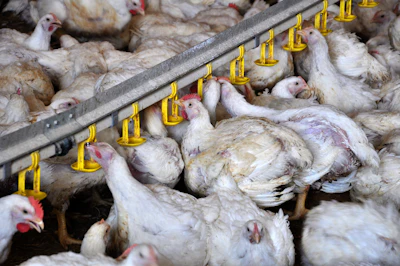
Gut health is now recognized as a cornerstone of broiler performance, and polyphenolic compounds administered through drinking water lines represent one emerging approach to supporting intestinal integrity and reduce Salmonella loads from day one.
"Next to the brain, the intestinal tract has the most neurons that help the animal fight off different conditions such as stress and intestinal infections," said Dr. Conrad Schmidt, Precision Health Technologies’ chief science officer. "A healthy intestinal tract gives you a healthy animal."
Polyphenols are naturally occurring plant compounds that accelerate healing in response to cellular damage. A water-soluble formulation delivers antimicrobial activity directly within drinking water lines, reducing pathogen pressure both inside the bird and in the surrounding environment.
Designing a real-world trial
An independent safety study through the Southern Poultry Research Group evaluated polyphenol’s ability to reduce Salmonella under conditions that closely mirror commercial reality.
Because the U.S. broiler industry relies on reused litter in virtually all production, researchers took litter from a previous study and contaminated it with Salmonella Enteritidis before introducing 42-day-old birds.
Two treatment windows were evaluated — six days and three days prior to simulated processing — followed by a 12-hour feed withdrawal. Researchers then collected boot sock, crop and cecal samples to measure not just Salmonella prevalence but actual pathogen load.
The results followed a clear pattern. Birds treated for six days prior to processing showed the greatest reduction in Salmonella Enteritidis in both the crop and ceca, while the three-day treatment group fell between the six-day group and the untreated challenge control.
"The fact that we had the three-day being intermediate to the six-day gave me pretty good thoughts that this product may be doing something," said Chuck Hofacre, president of the Southern Poultry Research Group and an emeritus professor at the University of Georgia.
Beyond Salmonella
Dr. Roxana Sanchez, DVM, consultant at RSI Poultry Veterinary Consulting, emphasized the value of early-life application for polyphenols beyond pre-harvest use.
"Once the organs are very well developed, and the microbiome is established in the first weeks of age, you will have benefits that you can see for the rest of the production cycle," she said.
Sanchez noted that polyphenols have shown utility against Salmonella, Clostridium and coccidiosis, making it relevant for both food safety and flock health programs.
"If you can show an effect against Salmonella, it's pretty much a given you're going to have an effect against other bacteria too," added Daryl Hammer, senior product specialist with Precision Health Technologies.