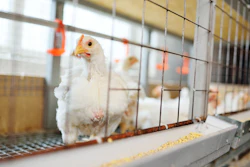
Catmint oil vapor shows potential for preventing the airborne transmission of highly pathogenic avian influenza (HPAI) in commercial poultry operations
In a study published in the journal Hygiene, researchers at the University of New South Wales testing catmint-oil-based formulations found that vapors rapidly inactivated airborne viral particles. In controlled tests, a catmint oil formulation reduced H1N1 viability by 99.9% within just two minutes when aerosolized in a closed chamber.
“This makes it a promising candidate for spatial disinfection in environments like commercial poultry houses to prevent airborne disease transmissions,” said Peter van Bruinessen, one of the authors of the study and product developer at Vapour Science.
Recent research suggests that HPAI transmission likely involves multiple overlapping pathways, including direct contact, airborne or combinations of both.
How catmint oil disinfects
The research revealed catmint oil's mechanism of action.
Using electron microscopy, scientists discovered that the catmint-oil-based formulation disrupts the protective outer envelopes of viruses, causing them to break apart and become harmless. This envelope disruption is what makes the technology effective against respiratory viruses, like HPAI, that depend on their outer coating to infect cells.
Catmint oil is a highly concentrated essential oil steam-distilled from the leaves and flowering tops of the Nepeta cataria plant, a member of the mint family. Its primary active compound is nepetalactone, which produces a distinct herbaceous, mildly minty aroma and carries the antimicrobial properties, explained Van Bruinessen.
Implementation advantages
In some facility configurations, catmint fog could integrate seamlessly with existing infrastructure.
"It may be possible in some cases to transport and distribute catmint fog through existing overhead piping systems," he said, eliminating the need for additional capital investments that producers would otherwise face adopting new disinfection technologies.
Beyond HPAI prevention, catmint oil functions as a natural insect repellent — a property that could reduce mite and louse populations in nesting areas — while potentially supporting gut health and digestion in flocks.
Remaining questions
Standard environmental precautions and routine infection prevention measures remain essential alongside any catmint oil application, van Bruinessen emphasized.
"Standard environmental precautions and routine infection prevention measures still apply," he said, adding that further investigation is needed into product formulation.
"Investigating if a hydrogenated version of catmint oil could also be suitable for air fogging inside poultry farms" represents a critical next step for commercial deployment, he noted.
View our continuing coverage of the global avian influenza situation.