The Climate Transition Plan explains how Cranswick, which specializes in premium, fresh and added-value food products based on fresh pork and poultry meats for the U.K. market, will transition its business into one achieving Net Zero by 2050.
Developed in line with the recommendations of the Transition Plan Taskforce (TPT) and guidance for the food and beverage sectors, this Climate Transition Plan is a first for Cranswick PLC.
“This reinforces our intent to help shape a more secure, sustainable, and resilient food system for the future,” said the group’s CEO Adam Couch as he introduced the company’s first Climate Transition Plan.
“This transition plan focuses on practical actions that lower emissions, support our supply chain, and drive long-term sustainability across our food system,” said Adam Bower, who is Cranswick’s head of sustainability.
The launch followed a company announcement that Cranswick has recently updated and validated its targets in line with Science Based Targets initiatives (SBTi) Forest, Land and Agriculture (FLAG) guidance.
Key focus of the Plan is setting out the company’s actions to reduce greenhouse gas (GHG) emissions. At the same time, it aims to increase resilience to climate-related risks, and future-proof the organization in a Net Zero world.
To achieve these aims, the company has developed strategies to reduce its carbon footprint, adjust its operations, and align its strategies with wider climate goals according to the Paris Agreement.
To do so, Cranswick says it has integrated science-based targets, financial planning, and Environmental, Social, and Governance (ESG) pillars with the changes that are needed to its existing assets, operations, and the wider value chain.
Ambitions on emission reduction
In its Climate Transition Plan, Cranswick states that its total emissions and targets have not changed. However, they are now recorded separately, taking into account emissions from Forest, Land, and Agriculture (FLAG). FLAG emissions are those arising from land-use change (such as deforestation) and land management (such as manure management and fermentation from the digestive systems of animals). In contrast are other emissions that result from the combustion of fossil fuels.
As the company produces and sources raw materials from both forestry and agriculture, it now reports FLAG emissions separately from its energy and industrial emissions.
Cranswick has set out its science-based targets as absolute reductions in emissions from a 2017-2018 baseline.
By 2030, the target reductions are 68% for manufacturing and its value chain, and 36% for the FLAG value chain. These reduction targets rise to 90% and 72%, respectively, to reach Net Zero by 2050.
Action on Agriculture
Towards its Net Zero goal for agriculture, Cranswick reports its had achieved a 10.4% reduction from the baseline in 2024-2025 for agriculture.
Because of their biological nature, the company says, agricultural emissions are challenging to mitigate. However, Cranswick sees potential for decarbonization through the refining of animal performance, re-purposing of manure, and support for regenerative farming.
Contributing to the first of these is the group’s recent acquisition of the Fridaythorpe feed mill. Together with its other three mills, this increases the group’s self-sufficiency in feed, and offers opportunities to source its own chosen feed ingredients.
Furthermore, integration of pig genetics company JSR Genetics Ltd into the group opens opportunities to utilize improvements in performance, meat quality, and animal health for long-term benefits in terms of FLAG emissions.
Progress on decarbonizing products, feed
In order to make progress towards Net Zero, Cranswick has identified the necessity to make changes to existing products, and to develop new ranges.
As well as introducing improvements to packaging, the carbon footprint of the group’s livestock production could be reduced by employing best husbandry practices and optimizing feed sourcing.
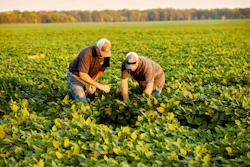
Among the key focus areas is soy — reducing the reliance and impact of soybean products in poultry and pig nutrition. To achieve this, the company can reduce the emissions from land use change by sourcing deforestation-free soy, substitute soy with grains or other proteins, and source soy with a lower global warming potential (GWP).
Cranswick reports that it has been improving the deforestation-free status of its purchased and embedded soy since 2021.
For purchased soy, it reached 100% full mass balance (FMB) certified soy for poultry feed in 2022, and for pig feed two years later.
Starting in 2025, the group has been upgrading to verified deforestation and conversion-free (vDCF) soy. Currently, it reports 93% and 30% vDCF in its poultry and pig feeds, respectively.
In terms of embedded soy, latest figures are 100% FMB for poultry, and 71% for pig feeds.
Cranswick says it will continue to work to deliver on a commitment to 100% vDCF soy in line with the UK Soy Manifesto.
More on Cranswick PLC
Annual slaughtering of around 62 million chickens in 2025 puts Cranswick among the largest poultry meat producers in Europe, WATT Poultry Top Poultry Companies database.
Based in the U.K., Cranswick PLC specializes in the production of premium, fresh, and added-value food products in segments fresh pork, poultry, convenience and gourmet products, as well as pet products.
For the last financial year, the company reported a 22% increase in operating profit compared to the previous 12 months, while group revenue was up by almost 10%.