Digitally integrating poultry farm and processing operations with artificial intelligence could eliminate manual data entry, communication delays, and siloed decision-making.
Poultry farm data and factory data tend to live in separate systems, spreadsheets or paper forms, with no reliable mechanism for sharing information in real time. Processing plants end up planning around assumptions, and farms rarely receive meaningful feedback on how their birds actually perform once they reach the plant.
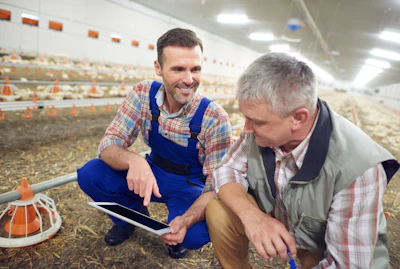
By connecting poultry farms and processing, plants can receive production data – including quantities, average weights and antibiotic status – before birds arrive. In return, slaughter performance data flows back to farm managers, giving live operations teams feedback on catch crew performance, mortality causes, and weight variances.
Treating farms and processing plants as separate data environments, even within fully integrated companies, leaves significant money on the table, said Paulo Gaspar, CEO, BRAINR.
A consolidated industry needs consolidated data," he added.
Processors should begin digital transformation with production management systems before tackling enterprise resource planning (ERP) replacement, and plan to implement one factory section at a time rather than attempting a full cutover.
In the future, a QR code on a retail tray could back to the parent flock and farm of origin, Gaspar said, and retailer demand for that level of accountability is only growing.
Start by digitizing feed data
Feed consumption sensors are central to closing that gap, explained Simon Cohen, VP, MTech Systems. Algorithms that can predict incoming bird weights and bell-curve weight distributions give factory planners reliable data to schedule production lines in advance rather than reacting to what shows up at the receiving dock.
Feed, he noted, represents approximately 70% of the cost of poultry production, making real-time consumption data one of the highest-value inputs in the supply chain.
Integration in action at Lusiaves Grupo
Lusiaves Grupo, a Portuguese family-owned company processes more than 150 million birds per year and runs roughly 150,000 birds per day across more than 1,000 SKUs. Managing director Diogo Ferreira said that before integrating the data, the operation was routinely making production decisions based on incomplete or late-arriving information from farms.
"We often only knew too late what was arriving," Ferreira said. "Each team was working with partial information and decisions were not fully aligned."
Ferreira said the effect was a shift from reactive management to something closer to genuine operational control. Catch crew performance, previously difficult to evaluate systematically, became measurable. Payments to growers became easier to reconcile. Recurring problems that previously had no feedback mechanism to surface them became visible.
One of the more significant developments on the farm side involves estimating bird weights before trucks are ever loaded.
Sensors mounted on feed bins inside grow-out houses could collect consumption data continuously, and algorithms use that information to estimate not just average flock weights but the full distribution curve of birds in a given house. Shared with factory planners in advance, that data could allow production lines to be configured for what is actually coming rather than adjusted after the fact.