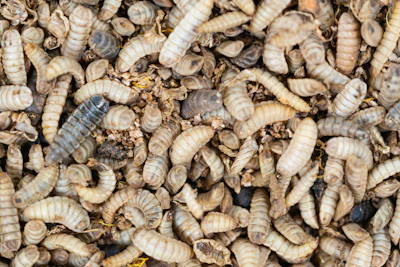
Allowing broilers to forage for black soldier fly larvae can improve flock health and welfare while supporting commercial performance, according to new research published in Applied Animal Behaviour Science that could challenge the poultry industry to rethink enrichment from the ground up.
Emily Burton, professor of Sustainable Food Production at Nottingham Trent University, reached the conclusion following the Feed Flow project, which integrated black soldier fly larvae (BSFL) into commercial broiler systems as a form of enrichment.
"When we take seriously how chickens perceive, explore and interact with their environment, we can measurably improve both welfare and system performance," Burton said, adding that enrichment should be embedded into the fundamental design of production systems rather than bolted on as an afterthought.
Tracking behaviors when insects are added
During the study, camera-based measurement tools allowed researchers to track behavioral interactions over time and across flocks.
Scattering BSFL throughout the pens increased total active behaviors in fast-growing broilers by more than 11% and foraging behavior grew 32%, compared to when BSFL were offered in the feed trough.
“The Feed Flow project demonstrates that it is possible to integrate meaningful enrichment into commercial systems in ways that support natural behaviors without compromising efficiency. In fact, systems that allow birds to express positive behaviors can be more resilient, more predictable and more socially acceptable in the long term,” Burton explained.
Chickens are naturally motivated to peck, scratch, forage and explore, however, when housing systems restrict those behaviors, frustration, injurious pecking, uneven space use and heightened management demands can occur.
In the wild, poultry will naturally eat insects, considered to be a protein-rich food source high in energy such as lauric acid, a C-12 saturated fatty acid with demonstrated value-added, antimicrobial and antibacterial properties.
Additional benefits of BSFL as enrichment
The research also carries urgent practical relevance. As highly pathogenic avian influenza continues to drive extended indoor housing periods to slow the spread of the virus, enrichment capable of replicating natural foraging behavior becomes increasingly critical for maintaining flock welfare when outdoor access is not possible.
“Enrichment approaches like live insect feeding allow birds to engage in natural foraging behavior even when outdoor access is not possible, helping to mitigate some of the welfare constraints associated with prolonged indoor housing,” Burton argued.
Another benefit of using BSFL as broiler enrichment is its potential as a platform for upcycling low-value substrates into high-value fractions. The use of insects to bioconvert byproducts from other food production, like food waste, manure and other agricultural waste streams, could potentially minimize waste and upcycle nutrients, improving the sustainability of the poultry supply chain.
The Feed Flow project has been developed throughout in close partnership with commercial producers, integrators and practicing veterinarians, whose operational knowledge has shaped both trial design and the interpretation of results.