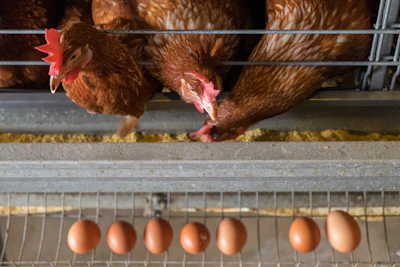
Driven by a desire to reduce downtime, improve sustainability and hold onto the strong egg market that took shape after COVID-19, more U.S. producers are raising layer flocks to 100 or even 110 weeks without molting. The longer that cycle runs, however, the less margin there is for early nutritional shortcuts.
"This now puts a lot of pressure on the bird, because you're going to keep them for an extended period of time without molting," Colwayne Morris, Ph.D., technical account manager for Zinpro Poultry, said. "It is very important to pay attention to your nutrition and to understand the relationship between egg production, eggshell quality and skeletal integrity, especially in this extended period."
"The pullet phase is your investment phase," he added. "There's not much you can do when the error has already been made towards the end."
Three factors that determine longevity
There are three interconnected factors that determine whether a bird can hold up through an extended production cycle: robustness, skeletal health and laying persistence, Morris said. All three are shaped most decisively during the pullet phase.
"You're not getting eggs from those pullets, but you'll get good quality eggs at the end," he explained. "Make the investment first."
Robustness, the bird's ability to withstand stress, disease and post-vaccination challenges, must be established early. Without it, birds enter the laying period already compromised, with less capacity to sustain production over the long haul.
In addition, skeletal health is particularly critical.
The medullary bone — which serves as a mineral reservoir hens draw from during egg production — is built during weeks 15 and 16 of development and cannot be rebuilt later. If that foundation is weak, birds will deplete bone mineral reserves faster than they can be replenished through diet, leading to declining eggshell quality, increased fractures and welfare concerns well before the end of a target production cycle.
"The other aspect that we want to look at as well is the laying persistence. If that skeletal system is built and so on, that bird could now lay throughout to that 100 week, 110 week period, because it has a really good foundation and really good nutrition there as well,” he added.
Trace minerals including zinc, manganese and copper can be central to building that foundation. Manganese plays a specific role in glycoprotein synthesis, which governs eggshell membrane formation, while also contributing to bone structural development. Zinc supports immune response and skeletal integrity.
"For a building to stand, you want to have a really good foundation," Morris said. "You want to invest in that particular phase to make sure that the birds have really good structural health."