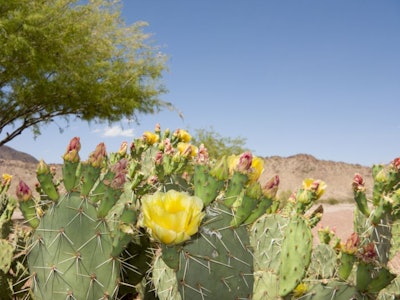
With its drought resistance, tolerance to salinity and high yield, the prickly pear has long been valued as a feed material during drought periods in Namibia. However, new research has identified the plant as a possible regular ingredient in diets for ruminants.
Belonging to the genus Opuntia, there are many species and hybrids of the prickly pear — or cactus pear — thriving in arid regions. With a wide variation in size, flower color and spikiness, all species form edible fruits and cladodes (“leaves”). Combined with the plants’ adaptability to a range of growing conditions, there is increasing interest in the plant as a feedstuff in Namibia, reports New Era.
Another advantage of the plant is its affordability, according to the researchers in a report to the country’s agriculture ministry. In combination, these characteristics indicate the potential of the local prickly pear (O. ficus-indica) for the livestock of the subsistence farmers of the southern African state’s arid regions.
Widely regarded as a weed, the prickly pear has been proposed as a useful feed ingredient for livestock in southern Africa.
With its drought resistance, tolerance to salinity and high yield, the prickly pear has long been valued as a feed material during drought periods in Namibia. However, new research has identified the plant as a possible regular ingredient in diets for ruminants.
Belonging to the genus Opuntia, there are many species and hybrids of the prickly pear — or cactus pear — thriving in arid regions. With a wide variation in size, flower color and spikiness, all species form edible fruits and cladodes (“leaves”). Combined with the plants’ adaptability to a range of growing conditions, there is increasing interest in the plant as a feedstuff in Namibia, reports New Era.
Another advantage of the plant is its affordability, according to the researchers in a report to the country’s agriculture ministry. In combination, these characteristics indicate the potential of the local prickly pear (O. ficus-indica) for the livestock of the subsistence farmers of the southern African state’s arid regions.
Pear’s potential as a feed for sheep
According to the Namibian researchers, the prickly pear is best fed in combination with other feedstuffs. Mixed with even low-quality forage, it improved intake, nutrient digestibility and growth rates of sheep.
In the early 2000s, a series of trials in South Africa revealed that the dried and coarsely ground cladodes could successfully replace up to 36% of the alfalfa hay and corn in rations for young lambs of the local breed, Dorper.
Subsequently, researchers in Namibia and South Africa investigated the feeding of a similar product to Dorper wethers during finishing on a feedlot.
In their paper published in Agricola in 2010, they reported a trial in which the sheep received a diet including approximately 30% of a similar dried and ground prickly pear material. Supplemental nitrogen was added to these test diets as urea or sunflower meal. Growth and carcass composition were compared with a control group receiving a standard alfalfa hay and corn ration.
Growing performance was similar for the control diet and those receiving the test diet supplemented with sunflower meal. While those fed the pear-and-urea diet grew more slowly, and did not reach normal market liveweight, carcass weights were similar for all three groups. There were few statistically significant differences between the groups in terms of carcass composition.
With the lower unit cost of the pear-based diets compared to the control, the researchers suggested that a full economic analysis was needed to identify the best dietary option for finishing Dorper sheep. Furthermore, they highlighted the importance of the nitrogen supplement when feeding prickly pears.
Feeding prickly pear to beef cattle
In the 1990s, Joe C. Paschal, Ph.D., of Texas Cooperative Extension reviewed the practice of feeding prickly pear to cattle in southern Texas and northern Mexico. The plant had been widely used as a forage substitute for decades, he reported in a paper published in AgriLife.
In these regions, the most common species — O. engelmanni (Englemann), O. lindheimeri (Nopal), and O. polyacantha (Plains) — are unsurprisingly different from Namibian natives.
While the composition of the prickly pear varies with species and stage of growth, the plant is known for its high moisture content. It also contains energy, fiber and minerals, but it is low in protein. Early last century, use of the prickly pear was widespread in the region for dairy and beef cattle, sheep, goats and swine.
Singeing of the spines can improve the usefulness of the pears for cattle feeding. However, the animals will also eat the young fruit before the spines become hard.
Consumption of large amounts of the material can lead to scouring (diarrhea) in cattle, but not enough to cause disease. When fed on its own, “pear balls” of undigested fiber can develop in the rumen, blocking the digestive tract. In both cases, these issues can be prevented by feeding some alternative forage.
In his conclusions, Paschal stated that prickly pear is an excellent natural resource to use in supplementing beef cattle as an emergency feed ration. On the other hand, its role in today’s ranch industry is limited by a lack of recent research, and economic evaluation.