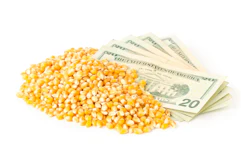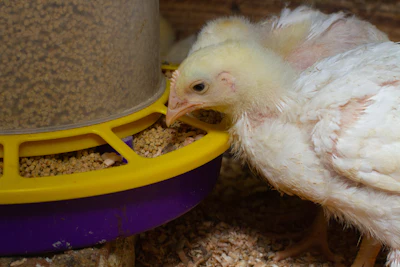
Poultry producers face significant feed cost increases in 2026 as drought conditions across the U.S. midsection drive corn and soybean meal prices higher. With feed accounting for up to 70% of broiler and turkey production costs, prices are projected to average $5.00 to $5.50 per bushel for corn, roughly $1 higher than the previous season.
- Feed costs represent up to 70% of the total cost to raise commercial broilers and turkeys, making price volatility a critical concern for producers
- Corn yield projections dropped from 180.7 to 178.5 bushels per acre as drought conditions worsened from July through September
- Corn prices expected to average $5.00-$5.50 per bushel in the 2026/27 marketing year, up approximately $1 from the previous season
- Crop quality declined significantly with good or excellent ratings falling from 67% in July to 57% by mid-September, below the 5-year average
- Limited carryover stocks mean little flexibility in supply projections, intensifying price pressure on poultry integrators
Feed can easily account for up to 70% of the cost of raising commercial broilers and turkeys, and it is the most volatile input by far, so poultry integrators are well aware of the vigilance required to stay on top of trends in this space and prepare accordingly. Nevertheless, it is still jarring when the tide turns from a bear market to a bull market for either corn or soybean meal but especially when it happens to both.
Fueled by an ill-timed drought across much of the nation’s midsection, resurgent feed input markets are rapidly becoming one of the top storylines of 2026. Harvest is underway across much of the southern U.S., meaning it is effectively too late to recoup a significant amount of the yield damage incurred by drought conditions to this point.
Conditions were ripe for a turnaround
To be fair, the recent surge wasn’t completely out of the blue as there were numerous warning signs from much earlier this year suggesting that feed input markets – and corn especially – were vulnerable to rally.
Financial stress in the farm community reached a fever pitch in the aftermath of the 2025 season with crop prices depressed pretty much across the board. In addition, despite being the “offseason” for plant growth and development, severe and pervasive drought manifested as a concern through winter and early spring.
That raised the possibility of farmers planting less total acreage this year, with corn an easy target for reduction by offering weaker implied returns than most alternatives based on futures prices at the time. Yields also seemed like a safe bet to underwhelm barring a major shift in precipitation patterns.
Inflaming the situation, the U.S. launched a military operation against Iran, upending global fuel and fertilizer markets just as farmers were finalizing planting decisions.
A tale of two growing seasons
While the mood was definitely bullish once spring planting was in full swing, it had shifted by the time farmers were winding down the planting season with beneficial rainfall blanketing much of the nation’s midsection where it was desperately needed.
That was immediately followed by the U.S. Department of Agriculture (USDA) discovering that farmers hadn’t reduced total crop acreage, and corn specifically, as much as originally thought. This put grain markets on the defensive, which lasted until a few weeks into July when drought returned with a vengeance.
As of Sunday, July 19, 67% of the U.S. corn crop was rated either good or excellent according to the USDA in its weekly Crop Progress report. However, by Sunday, September 13, that figure had plunged to just 57%, well below the 67% rated good or excellent at the same point last year and also short of the most recent 5-year average of 59%.
Consistent with that, the USDA just lowered its projected average U.S. corn yield for the current year, valid as of September 1, to 178.5 bushels per acre (bpa) from 180.7 bpa last month and an early-season trend-yield forecast of 183.0 bpa. Some private analysts expect the final average to end up at least a few bushels below that.
Based on speculation about usage (or “demand”) for the 2026/27 marketing season, there won’t be much wiggle room in carryover stocks. Current supply projections appear consistent with corn prices averaging between $5.00 and $5.50 per bushel on a cash basis across the U.S. during the new marketing year. That would represent an increase of approximately $1 from the 2025/26 season, and the soybean meal market is similarly ascendant. Poultry integrators are left hoping that this bull-cycle for feed input markets doesn’t spiral out of control to a similar or worse degree as past cycles.