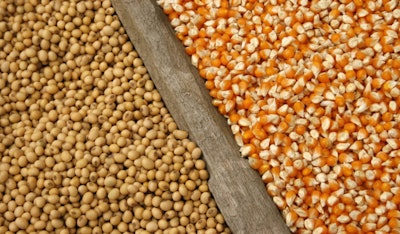
On a weight (or more correctly, mass) basis, cereals appear to be among the least expensive raw materials in most animal feeds. Indeed, it is only salt and limestone that are significantly cheaper than cereals (including their byproducts such as bran, for example). However, there is a nutritional axiom saying energy is the most expensive nutrient in any animal feed. So, how is this paradox explained when it is cereals that provide the bulk of energy?
Let us examine a simple (typical) animal feed, say, for broilers. It contains about 70% corn, 20% soybean meal, and 10% other ingredients that have no energy value (for this example, at least). U.S. spot prices as of late October 2022 for corn are US$6.98 per bushel. Similarly, spot soybean meal costs US$408 per short ton. Let us now convert these numbers in USD per kg: corn=US$0.28 (rounded up) and soybean meal=US$0.45 (rounded up).
Next, we need to multiply the inclusion rate with the price of each ingredient, forgetting for this discussion the cost of the “other” ingredients. The total cost of corn per metric ton is then 0.28×700=US$196, while that of soybean meal is 0.45×200=US$90. Forgetting that some synthetic amino acids are invariably included in the “others” package, we can see that the cost of energy (corn) is more than double the cost of protein (soybean meal).
For a broiler producer with 10 million birds per year, savings on cereal grains can really add up
On a weight (or more correctly, mass) basis, cereals appear to be among the least expensive raw materials in most animal feeds. Indeed, it is only salt and limestone that are significantly cheaper than cereals (including their byproducts such as bran, for example). However, there is a nutritional axiom saying energy is the most expensive nutrient in any animal feed. So, how is this paradox explained when it is cereals that provide the bulk of energy?
Let us examine a simple (typical) animal feed, say, for broilers. It contains about 70% corn, 20% soybean meal, and 10% other ingredients that have no energy value (for this example, at least). U.S. spot prices as of late October 2022 for corn are US$6.98 per bushel. Similarly, spot soybean meal costs US$408 per short ton. Let us now convert these numbers in USD per kg: corn=US$0.28 (rounded up) and soybean meal=US$0.45 (rounded up).
Next, we need to multiply the inclusion rate with the price of each ingredient, forgetting for this discussion the cost of the “other” ingredients. The total cost of corn per metric ton is then 0.28×700=US$196, while that of soybean meal is 0.45×200=US$90. Forgetting that some synthetic amino acids are invariably included in the “others” package, we can see that the cost of energy (corn) is more than double the cost of protein (soybean meal).
Let us now assume we have to feed 1 million broilers, each consuming roughly 5 kg feed (heavy market broilers). This single flock alone (fed for about 6 weeks) will need 5×0.7×0.28x1m=US$980,000 as capital expenditure alone on corn. The same number for soybean meal is US$450,000. If we accept a period of slightly less than a week between flocks, then we have roughly 7.5 flocks per year, and this brings the bill up to US$7.35 million for corn and US$3.38 million for soybean meal. In rough numbers, there is a ratio of corn to soybean meal feeding cost in the area of 2:1 that can be used for several business calculations regarding financing, etc.
The question next becomes one of time versus profit. Let us assume that the broiler farmer has one hour per week to source corn or soybean meal. Where should such a farmer spend more time to find a better price? Would that be on corn or soybean meal? Ideally, best prices should be ensured for both ingredients, but a 10% better price on corn will bring back better profits than the same time spend to secure 10% better price on soybean meal. Crunching the numbers, we see that with 10% less expensive corn, the expenditure becomes roughly US$880,000 (US$100,000) per flock, whereas the same for soybean meal gives roughly US$400,000 USD (US$50,000). An average broiler producer has about 10 million birds per year. Then, these numbers suddenly become really important for the survival and profitability of such operation.