Once hailed as a breakthrough that could transform the feed industry, insect-based ingredients quickly moved from laboratory trials to industrial-scale projects. Yet several years on, the early hype has given way to a more measured reality. Regulatory barriers, high production costs, and slower-than-expected market uptake have noticeably tempered expectations in the past few years.
In the early 2020s, several analysts projected the insect protein segment to boom through 2030. Strategic Market Research, a consultancy, estimated that the global insect protein market was worth US$268.7 million in 2022. The analysts expected the market to expand at an average of 31.5% per year, reaching US$4.1 billion by 2032.
The International Platform of Insects for Food and Feed (IPIFF) estimated that European insect protein output could grow from just a few thousand tons in 2020 to approximately 1 million tons of capacity by 2030, with the sector potentially creating up to 25,000 jobs across the value chain.
However, the reality has so far proven more modest. While analysts lack consensus on the current global insect market size, it is clear that actual sales volume has not even come close to the projections made at the beginning of the decade.
Moreover, several high-profile projects that were expected to make tectonic shifts in the feed industry have spectacularly failed.
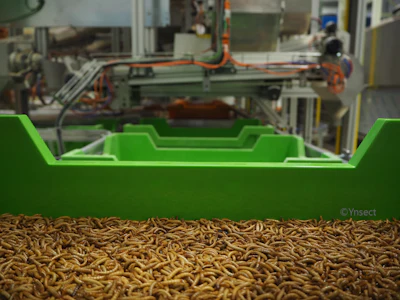
Most recently, French insect protein giant Ÿnsect was placed into judicial liquidation in December 2025 after failing to secure funding to overcome persistent financial, technical and high operational cost challenges. Despite raising more than US$600 million, the firm reportedly struggled with high energy costs, technical issues at its main factory, and uncompetitive pricing for its mealworm protein.
Systemic issues
One of the key brakes on the wheel of the insect protein project was that, despite significant innovations, the industry failed to overcome some long-standing issues, including high costs and quality concerns.
The insect meal challenges were well flagged years ago, said Aidan Connolly, president of AgriTech Capital.
"We understood then that insect meal needs to be cheaper than fishmeal and perhaps soy protein isolates, consistent nutritional profile, safe. Mostly these have been achieved, but not entirely and so, aside from pet food, adoption has been curtailed," Connolly said.
Besides, Conolly continued, questions have been raised about the limits of inclusion in animal and companion animals, with issues of palatability and the suspicion that compounds such as chitin might trigger allergic reactions.
"While this is still not fully defined, the role of insect protein as an option in pet food, aquaculture and poultry production has been dogged by these doubts," Connolly said.
The insect-based feed industry — particularly in Europe — has experienced a noticeable slowdown as the sector has moved beyond early hype into an industrial phase. Beyond the Ÿnsect liquidation, the difficulties have contributed to the bankruptcy or restructuring of several other prominent projects, including Enorm Biofactory and Agronutris.
Cost remains a central challenge: Insect protein carries a significantly higher price tag than conventional ingredients such as soybean meal or fishmeal, and production is capital-intensive, requiring large, automated facilities. Economic turbulence in recent years has compounded the problem, and when financing conditions tightened, some companies struggled to sustain expansion plans.
Regulatory progress in Europe has improved but continues to limit the addressable market, particularly for poultry and pig feed applications. Feed manufacturers, meanwhile, remain highly price-sensitive and prioritize consistent supply and proven performance. Scaling insect production to industrial levels has also proven biologically and operationally complex, slowing the path to profitability across the sector.
Emerging markets underdeliver
At the beginning of the decade, analysts expected emerging markets in Asia, Africa and Latin America to be among the key drivers of insect protein industry growth. For example, Strategic Market Research pointed out that some of these regions are culturally more open to incorporating insects into their diets, so their mass adoption in the feed industry can be more straightforward.
Moreover, the analysts noted that these countries also face problems with regard to food security and inadequate protein intake.
Governments along with private sector players are channeling resources into setting up facilities for rearing insects for human consumption besides promoting their use as alternative cheap sources of proteins, the analysts said.
Some noticeable progress has been made in China, as black soldier fly (BSF) farms in provinces such as Shandong and Guangdong already produce approximately 100,000 tons of insect-based feed per year, which is being tested in poultry, pig and aquaculture diets. However, large-scale adoption remains constrained by costs, as soymeal is still typically cheaper than insect protein.
In Russia, where some forecasts suggested insect protein production could reach 150,000 tons by 2030, the industry is not getting close to meeting this target. Although some pilot projects have been launched over the past few years, the industry remains reluctant to accept insects as feed ingredients.
Insect production has seen some promising developments in Africa, according to Dorte Verner, lead agriculture economist and global lead for alternative protein in the food and agriculture global practice, World Bank.
"There is a huge demand for insect-based feed in everything from the production of caviar in Madagascar to poultry, pig and fish feed in continental Africa as well as pet food in Europe," Verner said, adding that European pet food companies are increasingly signing contracts with several African producers since some of the large, overinvested European companies have paused production.
New insect-breeding farms are emerging across the continent, grappling with food security concerns and seeking new solutions to plug gaps in the supply chain.
"In most African countries, we have seen an explosion in black soldier fly production from both small and large farmers in the last three to four years," Verner said. "There is a rapidly increasing demand for high-quality protein, oil and minerals, which BSF larvae provide. We are seeing strong demand for World Bank Group support to grow this sector, most recently from Ethiopia, Madagascar and Senegal."
Future is still promising
However, despite the recent setbacks, analysts believe the industry still has substantial potential yet to be unlocked.
According to Connolly, there are reasons to be optimistic about the future of insect feed.
"I am very impressed by the industry coalitions' willingness to work together to get recognition for insect meal as a feed ingredient, the progress on insect genetics to find strains that are more prolific and robust, and a greater understanding that the food and feed stock affects nutritional content of the insect meal and indeed productivity of growth," Connolly said.
The key challenge for the insect industry is to find feedstocks that are free, or perhaps where insect meal producers are paid to remove the feedstock, Connolly said. This inevitably leads to animal manure or byproducts, food waste, and the challenges of ensuring that they are safe and free of contaminants.
"So still, lots to do, but at least a clear path ahead," Connolly added.