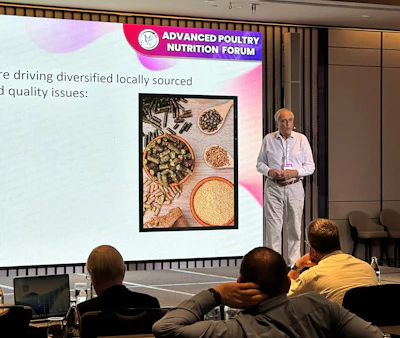
At the Advanced Poultry Nutrition Forum 2026, Dr. Julian Wiseman, emeritus professor of animal production and former head of division of animal sciences at the University of Nottingham's School of Biosciences, identified six feed additive categories most likely to shape antibiotic-free and antibiotic-reduced poultry nutrition programs over the next five years.
His analysis spanned mycotoxin management, medium-chain fatty acids, digestibility enhancement, raw material quality control and phytogenics, with gut health as the unifying thread across all of them.
1. Enzymatics replace mycotoxin binders
Mycotoxins impose an estimated 10–15% production impact on the poultry industry, equivalent to roughly US$375 million annually. Binders have been the default mycotoxin mitigation strategy for decades, but their ceiling is well established: Physiochemical adsorption cannot capture all toxin classes, and certain mycotoxins escape binding altogether.
The shift toward enzyme-based detoxification, which operates through a fundamentally different mechanism, provides targeted, irreversible destruction of the molecular structures responsible for toxicity. Once the structure is broken, toxic activity is eliminated.
Wiseman provided these examples:
- Laccases oxidize and destroy the lactone ring of aflatoxin B1.
- Lactonases, sourced from Clonostachys and Bacillus species, hydrolyze the lactone ring of zearalanone (ZEN).
- Dehydrogenases from gram-negative bacteria Devosia and Rhizobium oxidize deoxynivalenol's (DON) epoxide structure.
- Carboxypeptidases from Lysobacterium and Bacillus cleave ochratoxin's (OTA) amide bond.
Advances in protein engineering have improved enzyme activity, stability and scalability for commercial production. Wiseman believes the future is precision combinations — such as enzymes, binders and complementary molecules — applied at specific life stages of the bird.
2. Humic acid binds mycotoxins and protects the gut
Extracted from lignite, peat or compost, humic acid is a complex high-molecular-weight compound containing aromatic rings, phenolic groups, carboxyl groups and quinones. That chemical architecture gives it chelating capacity, i.e., binding mycotoxins and heavy metals similarly to clays and yeast cell wall products, and antioxidant activity that directly protects intestinal and hepatic tissue.
Wiseman described its value in terms of what it contributes beyond adsorption.
"Not only does it act as a versatile mycotoxin binder, but it also provides gut and liver protection, using its natural chemistry," he said, noting its limitation as a sole binder is acknowledged so it works alongside other mitigation strategies rather than replacing them.
3. Alpha-monolaurin leads MCFA formulations
Wiseman drilled into the chemistry that differentiates efficacy within the medium-chain fatty acid (MCFA) group. Lauric acid (C12) is the standout performer, rated highest in antimicrobial and antiviral efficacy among caproic (C6), caprylic (C8) and capric (C10). Within lauric acid chemistry, the alpha configuration of monolaurin is the defining variable.
Alpha-monolaurin (AML) disrupts bacterial membranes, reduces intracellular pH, interferes with DNA and protein synthesis, destabilizes enveloped viruses and modulates immune response. Critically, it acts locally in the gut and systemically.
"AML functions in the gut but also acts systemically, impacting the blood and lymphatic systems of animals," Wiseman said, citing commercially achievable 60-68% AML concentration is possible through enzymatic refining of palm kernel oil.
Emulsification amplifies potency further, he said. Bacterial inhibition ratios exceeding 87% work against E. coli at 600 ppm for emulsified AML, versus less than 5% for standard glycerol monolaurate at the same inclusion. The near-term formulation priority: combining AML with short-chain fatty acids for broad-spectrum coverage against gram-positive and gram-negative pathogens.
"AML and SCFA blends work together, strengthening the gut barrier, suppressing pathogens and supporting overall flock vitality — offering a proven AGP (antibiotic growth promoter) alternative," he said.
4. NSP enzymes + emulsifiers push digestibility forward
Non-starch polysaccharides (NSPs) are structurally diverse, and each require distinct enzyme activities. Wiseman emphasized that enzyme programs must accommodate this variation, which is why multi-enzyme NSPase blends are the direction, not single-activity products. Here, he noted findings from Nottingham suggesting xylanase may promote glucose uptake, an effect beyond its established role in viscosity reduction, though he presented it as emerging rather than definitive.
The more significant development is pairing enzyme programs with feed emulsifiers — specifically sodium stearoyl-2-lactylate (SSL), glycerol monostearate (GMS) and distilled monoglycerides (DMG). Emulsifiers disrupt the tightly packed starch granule matrix, improve gelatinization during conditioning and pelleting, and prevent post-pellet retrogradation, which expands the substrate surface area for enzymatic action.
The same principle extends to protein, he said. Emulsifiers reduce indigestible protein complex formation, improve solubility and enhance amino acid availability.
Wiseman stressed this is particularly relevant in markets where plant proteins dominate due to restrictions on animal-derived ingredients. On the fat side, better emulsification drives micelle formation, improving lipase access and absorption of fat-soluble vitamins A, D, E and K.
5. NIR makes trypsin-inhibitor monitoring practical
Trypsin inhibitors (TI) in soybean meal remain among the most consequential and undermonitored variables in poultry diet formulation. The assumption that standard heat processing reliably denatures TIs does not hold.
"I have data that shows the variability in commercially available soybean meals, which means that quality control is crucially important," Wiseman said. TIs interfere with protein digestibility, and protein entering the hindgut undigested creates conditions for necrotic enteritis via C. perfringens proliferation.
The practical constraint has always been analytical because wet chemistry TI assays are expensive, slow and require skilled operators, making routine quality control impractical for most mills. In the future, near-infrared spectroscopy (NIR) will be used to screen for TI levels simultaneously with protein content to enable fast, low-cost, at-line assessment.
6. Phytogenics shift to specific bioactives
Wiseman described phytogenics research as moving beyond broad plant extracts toward identifying the specific active molecules within essential oils.
"The future will be focused on the specific molecules within the essential oils, the phytobioactives," he said.
Phytobioactives address disease challenges without antimicrobial resistance risk, support gut health and nutrient utilization, and meet regulatory and consumer demands — including access to markets requiring antibiotic-free certification.
Across all six areas, Wiseman's unifying argument was that no single additive or strategy is sufficient. The One Health framework demands a systems view, integrating raw material quality management, targeted molecular solutions, biosecurity and precise, life-stage-appropriate applications.
"Developing alternatives to antibiotics is essential," he said. For "the health of poultry, the health of the consumer and the health of the environment and, don't forget, the market for poultry products."
Editor's note: The Advanced Poultry Nutrition Forum 2026, organized by Progressus, was held in Bangkok on March 9.