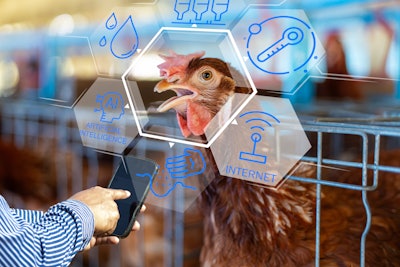
Artificial intelligence (AI) could simplify the complexities of the poultry gut microbiome to help producers optimize flock performance and health.
The poultry gut microbiome contains more than 800 identified bacterial species and many more that have yet to be classified. It plays a crucial role in poultry development, however its complexity has made it notoriously difficult to correlate with production outcomes.
The poultry gut microbiome is a relatively new concept. Analyzing its contents can provide insights into how feed additives, other nutrients and management practices positively or negatively impact poultry flock health, helping producers optimize diets for better growth rates, reproduction and overall performance.
Breed variations, temperature fluctuations, heat stress, feed composition and environmental factors all influence microbiome composition, creating an analytical challenge that has challenged traditional research methods.
"Usually scientists say that it is very difficult to correlate performance with the microbiome because of the complexity," said Luisa Gene, Galleon technology lead at Cargill. "The advantage of AI is that we are able to analyze large datasets and also correlate datasets."
This capability is enabling breakthrough applications. AI-powered analysis identifies specific biomarkers associated with performance and can predict pathogen presence — such as Salmonella and Campylobacter — with up to 90% accuracy based on microbiome composition alone.
This technology has analyzed more than 70,000 microbiota samples globally, including over 7,000 from poultry operations.
Revealing ‘microbiome signatures’
The practical application is surprisingly simple. Producers collect non-invasive cloaca swabs from approximately 24 birds per farm at strategic ages. The swabs are placed in tubes with a denaturant solution that begins DNA extraction immediately, eliminating contamination risks and refrigeration needs during shipping.
Gene explained that AI reveals unique "microbiome signatures" for different scenarios, from unexplained mortality to poor litter quality or suboptimal feed conversion ratios. Each farm possesses its own distinct microbiome profile, enabling customized nutritional and management interventions.
"We know that if we have a balanced microbiome, we will mitigate the risk of infection and the risk of developing disease," Gene said. The key to AI's success lies in database size — larger datasets produce more accurate pattern recognition and actionable insights that traditional analytical methods simply cannot achieve.