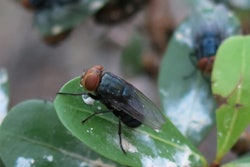
Mexico’s Secretariat of Agriculture and Rural Development (AGRICULTURA), through the National Service for Animal and Plant Health, Food Safety and Quality (SENASICA), reports that, after a notification from veterinary staff at an authorized third-party feedlot in Montemorelos, Nuevo León, an isolated case of New World screwworm (NWS) myiasis was promptly detected and addressed in a female bovine originating from southern Veracruz.
The emergency protocol for cases in a recognized NWS-free zone was immediately activated. Official personnel conducted an on-site inspection of the premises, collected samples for remote diagnosis, and applied the corresponding treatments. No additional affected animals were identified, confirming that this was an isolated case that was rapidly contained.
Based on the technical analysis conducted by SENASICA specialists, the following conclusions were reached:
- The infestation occurred prior to the animal’s arrival in Nuevo León (transit-related case).
- An active sterile fly release zone is maintained in the area, serving as a biological barrier that prevents reproduction of the pest.
- Immediate actions – including cleaning and disinfection, larvicidal treatment, pour-on/spray applications and thorough inspection of the herd – eliminated any possibility of local dissemination.
Current climatic conditions in Montemorelos (temperatures ranging from 11 C to 20 C and an altitude of approximately 500 meters above sea level) are unfavorable for the survival and reproduction of the screwworm fly.
SENASICA therefore determines that the risk of NWS establishment in Nuevo León remains minimal and that the epidemiological situation is fully under control.
To provide greater certainty to producers and the public, SENASICA has deployed specialized personnel to conduct epidemiological tracing and active surveillance for possible cases within a 20-kilometer radius of the affected site. Informational sessions will be held for local producers on the identification and early reporting of compatible lesions. Trapping will be intensified through the installation of additional traps at strategic locations, and coordination with USDA-APHIS will be strengthened to increase sterile fly releases in the region.
As an additional risk mitigation measure – and given that all detected cases in the state have been linked to cattle movements from NWS-affected areas – SENASICA announces the temporary suspension of cattle movements from those areas into Nuevo León. This measure will remain in place until the epidemiological investigation is concluded and full guarantees are in place that no infected animals or animals lacking proper inspection at Federal or State Inspection and Verification Points, as well as required preventive treatment in accordance with authorized protocols, enter the state.
SENASICA reaffirms that early detection, rapid response and close coordination with the livestock sector have kept the situation under control, ensuring no risk to livestock production in Nuevo León.