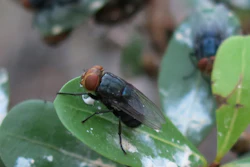
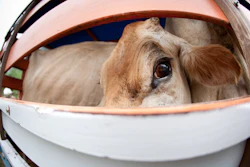
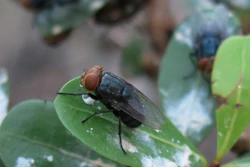
The Government of Mexico, through the Ministries of Agriculture and Rural Development (AGRICULTURA) and Science, Humanities, Technology and Innovation (Secihti), has established the Technical-Scientific Council of the National Strategy against the Cattle Screwworm (GBG) to strengthen scientific, technological and institutional capacities in favor of livestock, the livelihood of millions of producing families and the national food supply.
The measure responds to the instruction of the President of Mexico, Claudia Sheinbaum Pardo, to coordinate efforts with state governments, academia and the productive sector based on scientific evidence to combat New World screwworm (NWS).
That is why, in a hybrid meeting held at the Secihti headquarters, officials and researchers reaffirmed their commitment to strengthening the strategy that AGRICULTURE has been operating through the National Service of Agrifood Health, Safety and Quality (Senasica) for almost two years.
During the session, the representative of the AGRICULTURE technical team, Víctor Arrazate Argueta, highlighted that the strategy will move from an attention scheme based on a National Emergency Device to a national campaign for its control and eradication in the 32 federal entities.
He specified that the installation of the Technical-Scientific Council will strengthen inter-institutional coordination, territorial operations, communication and awareness campaigns, international cooperation, and research and technology transfer.
Among the priority lines of research are the strengthening of surveillance and diagnostic systems, early detection of cases, analysis of the population dynamics of the pest, evaluation and development of new methods of prevention, control and eradication, genetics and biotechnology studies, and the development of artificial intelligence technologies and tools, he noted.
Likewise, Arrazate Agueta highlighted the role of Senasica as the body responsible for the operation of the national health campaign — in coordination with state governments and the Livestock Promotion and Protection Committees — through permanent actions of epidemiological surveillance, training, notification of cases, control of animal movement and implementation of sanitary measures.
On behalf of the Undersecretary of Science and Humanities of the Secihti, Violeta Vázquez-Rojas Maldonado, the Deputy Director of Operational Management, Víctor García Velásquez, emphasized that the creation of this Council represents an opportunity to put the knowledge generated by the national scientific community at the service of the institutions responsible for the agricultural sector.
"The goal is for research and scientific, humanistic, technological and innovation development to reach decision-makers directly, thus strengthening the national strategy against the cattle screwworm," he said.
The general coordinator of the National Technical Advisory Council for Animal Health (Conasa), Luis Gelasio Sánchez Sanabria, called for synergy and affirmed that Conasa has 22 committees that have been working for 34 years on issues of animal health, production, and livestock management.
“There is work already done, and I am pleased that we are working together with researchers, listening to all efforts and actions so as not to duplicate time and resources,” he said.