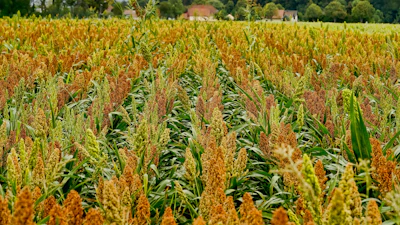
Climate change could raise sorghum yields across Europe enough for the crop to replace about 90% of the maize (corn) now used in livestock feed, according to research by France's National Research Institute for Agriculture, Food and Environment and AgroParisTech.
The study, published in the journal Earth's Future, projects that average European sorghum yields will rise from 3 metric tons per hectare under current conditions to 3.4 to 3.8 metric tons per hectare by 2050-2100, depending on the climate scenario. The 90% replacement figure assumes sorghum is grown one year out of three in rotation.
Sorghum is currently grown on just 0.1% of European cropland. The researchers found that the share of cropland able to support high and stable sorghum production would grow from 22% now to 29% to 34% by the end of the century. Yields would rise in northern Europe and fall slightly in southern Europe.
The appeal for feed is water. Maize is the main cereal in European livestock feed, but it is often irrigated; maize accounts for 38% of irrigated cropland in France, the institute said. Sorghum tolerates heat and low water availability, and most global production occurs in Africa (47%) and the United States (17%).
The timing matters for feed manufacturers. Maize yields hit a relative all-time low in the European Union this year, according to the institute, and France's most recent maize production estimate of 49.1 million metric tons was the first below 50 million in 16 years.
The mechanics of the study are straightforward. Researchers trained a machine-learning model on 11,644 historical yield data points from grain sorghum grown in France, Italy, Spain and the United States from 2000 to 2020. They then ran it against 20 climate scenarios generated by five climate models, using temperature, precipitation and relative humidity.
The researchers said wider sorghum use in France could ease pressure on water resources and free water for other crops, with the goal of increasing feed self-sufficiency. The study modeled yields and land suitability only; it did not assess feed formulation, grain prices or how quickly farmers might adopt the crop.