Tyson Foods is the largest broiler producer and third largest feed producer in the United States. It also ranks high among U.S. turkey, beef and pork producers.
A publicly traded company, Tyson finished the 2025 fiscal year with a net income of $507 million, despite challenging beef industry dynamics. As of April 29, its shares traded at $63.61.
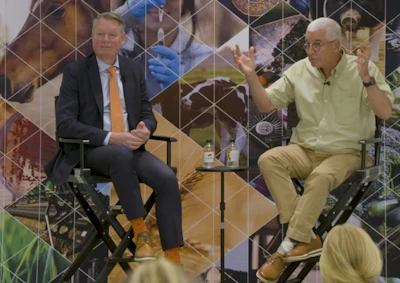
However, Donnie Smith, who served as CEO of Tyson Foods from 2009 to 2016, said business wasn't always that good. While joining Jayson Lusk, dean of the Ferguson College of Agriculture at Oklahoma State University, for a Dean's Dialogue on April 27, he spoke frankly of a time when it appeared the company was close to being forced to go out of business.
Smith received his formal education at the University of Tennessee at Knoxville, where he earned a bachelor's degree in animal science. He rose through the ranks at Tyson Foods until being named president and CEO.
A need-based financial education
After Smith mentioned that during his time at the helm of Tyson he spent approximately 25% of his time dealing with investors, Lusk asked how he learned to do that, because that is not typically something an animal science degree prepares you for.
It was then that Smith told of how he earned what he referred to as an informal "master's degree in finance from the Matt Chlystek School of JP Morgan" in a matter of 14 days.
Smith took over as president and CEO during tough financial times for the poultry and greater animal protein industry, following the financial crisis of 2008. Those tough economic times were exacerbated by high feed costs.
So much of his learning came out of a need to do or die.
Detailing what Smith referred to as a "little-known story," he said in 2008, the company "was not doing very well at all," and that fall shares of the company's stock dropped to approximately $4.
Smith wanted to do his part to save the company, so he bought as much stock as he could without borrowing money to do so.
"And then we added $1.3 billion to our capital structure between September '08 and March of '09, and if we hadn't have done that, we'd have lost the company. It was bad," he said.
In March 2009 he joined the company's then-chief financial officer, Dennis Leatherby, and Jim Lochner, senior group vice president of Tyson Fresh Meats. The trio went on a "two-week road show" where they sold high-yield bonds in an effort to raise funds.
Smith admitted he didn't even understand what a bond was at first.
However, it was during that two-week period that Smith met Chlystek on an airplane ride. When Smith learned that Chlystek was an investment banker for JP Morgan, he asked him question after question — even to the point that it appeared Chlystek was losing patience with him.
"Like on day five or six, he went to Dennis and he said, 'Is he ever gonna stop?' And he said, 'Nope, that's him,'" Smith recalled.
When Smith, Leatherby and Lochner returned to the corporate office, they learned they "won." They sold $810 million in bonds, with an effective interest rate of 12.5%. He called it "ugly money."
Just how dire was the need for that ugly money? Smith said that when they returned, Leatherby showed him a report indicating the company had "three weeks' worth of cash." The deal with the bonds closed on a Thursday. Then on Friday, the high-yield market shut down for 13 weeks.
"I mean, that's like Indiana Jones with the door dropping when he slides under and grabs his hat. I mean, we were that close to losing the company," he said.
Lessons learned and taught
Smith said that entire experience was a valuable learning opportunity, because before it his financial knowledge was extremely limited.
He wasn't the only one within Tyson Foods who didn't understand financial matters, either.
"They needed to understand why the balance sheet was so important, why the cash flow statement was so important, why return on invested capital was so important," Smith said.
"So I started teaching my friends what Matt Chlystek taught me and we made a shift over the next couple of years, thanks to Dennis and his wonderful finance team."
Leatherby passed away in 2018, not long after he retired from Tyson.
More thoughts on the past and present
As remarkable as Smith's story sounds, he was more than willing to credit the company's success to others while downplaying any role he might have had.
"I was really, really proud of what our team did … and really proud of the work. We made great food and we made a difference," Smith said. "I can look back at that with a real sense of accomplishment knowing I did precious little to help it. I had a great team that worked well together. I hope that doesn't change."
Following Smith's retirement from Tyson, he became active in helping develop the poultry industry in Rwanda and other parts of Africa. He came out of retirement in 2022 to become chairman and CEO of Foster Farms, remaining with that company until 2024. However, his tenure with Foster Farms was never discussed at the Dean's Dialogue.
Smith's work in developing resilient, sustainable food systems in Africa continues. He also serves as a member of the University of Tennessee Board of Trustees.
Footage of Smith's talk with Lusk can be found on YouTube.