Perdue Farms uses the One Health framework, which connects human, animal, and environmental health, to guide decisions on animal welfare, food safety, and sustainability. The approach recognizes that improvements in one area can benefit others, but also that trade-offs exist, requiring continuous system-wide improvement rather than optimizing single metrics.
- One Health Principles: Everything is connected, every system involves trade-offs, and continuous improvement across the whole system matters more than optimizing single metrics.
- Slower-Growing Breeds: While they improve mobility and welfare, they require more days, feed, and resources, demonstrating the trade-offs inherent in sustainable poultry farming.
- COVID-19 Lesson: The pandemic illustrated One Health in action—a zoonotic virus created cascading crises in animal welfare, worker health, economics, and food security.
- Innovations Underway: Perdue is testing probiotic vaccines, deploying AI-enabled smart houses for early problem detection, and trialing on-farm hatching to reduce salmonella spread.
- Future Focus: Rather than overcoming biological constraints to grow birds faster, the industry must understand and respect biological limits while designing systems that work in harmony with them.
Perdue Farms will continue to use One Health, a framework that links human, animal and environmental health, to guide its decisions on animal welfare, food safety and sustainability, a company leader said.
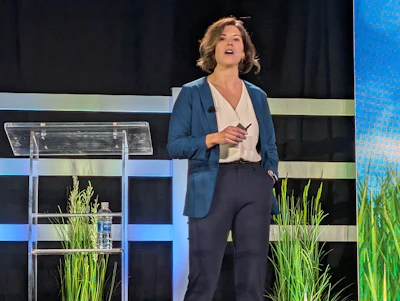
Kay Russo, DVM, Perdue Farms senior vice president of science and innovation, outlined the approach Sept. 30 in a talk titled "One Health in Action: Looking Ahead" at the company's 11th Annual Animal Care & Sustainability Summit in Salisbury, Md.
"Human health, animal health and environmental health are truly fundamentally connected," Russo said. "Improvements in one area can benefit another, but conversely, you can have inadvertent effects that ripple through that system."
Russo described the approach as being built on three principles: everything is connected, every system involves trade-offs and the company's job is continuous improvement across the whole system rather than optimizing a single metric.
"A system is perfectly designed to get the results that it gets," she said. Because the poultry industry reached its current state through decades of optimizing how birds are bred, fed and housed, she said, problems that system produces rarely have a silver bullet.
Trade-offs in practice
Russo spoke of slower-growing breeds as an example. They may improve mobility and other welfare measures, she said, but they need more days, feed and resources to reach market weight. If land use is held constant, fewer birds and less salable product reach the market.
Perdue's own evaluations also found economic benefits, she said, including stronger reproductive success in parent flocks that ultimately lowered hatching egg costs.
Measured on carbon alone, however, conventional birds outperformed the slower-growing breed on both high- and low-density diets. Russo warned against what she called "carbon tunnel vision."
"Carbon is only one outcome," she said. "When we consider welfare, survivability, food safety, economics, the decision becomes far more complex."
Customers ultimately define success through what they buy, Russo said. Perdue offers no-antibiotics-ever chicken across its labels, along with outdoor-access, organic and pasture-raised products. "We're not the least-cost company," she said.
Other One Health lessons
Russo called COVID-19 an extraordinary One Health case study. A virus that jumped from animals to people sickened processing workers and slowed or closed plants. That became an animal welfare crisis that in severe cases required on-farm depopulation, then an economic crisis for producers, workers and communities, and finally a source of food scarcity and higher prices.
Russo also cited Perdue's on-site wellness centers, where associates can see a physician or nurse practitioner during working hours, as One Health in action. Healthier workers mean stronger operations, she said.
What's next
Russo described innovations underway across the business. Perdue is testing a probiotic-platform vaccine recently approved in the U.S. and outfitting "smart houses" with sensors and artificial intelligence to predict bird performance and flag problems early.
The company has trialed on-farm hatching, which gives chicks early access to feed and water and avoids the commingling at hatcheries that can spread salmonella. It is moving one machine to the operations of Pasturebird, Perdue’s pasture-raised brand.
Perdue is also taking a systems-based approach to Salmonella that starts at breeder houses and feed mills, evaluating higher-welfare genetics, working to improve chicken's flavor and exploring ways to safely upcycle landfill-bound waste into animal feed.
She said the industry has spent decades overcoming biological constraints to grow birds faster on less feed, and has done it well. The next challenge is apt to be different.
"It may be less about overcoming biological constraints and more about understanding them, respecting them and designing systems that work in harmony with them," Russo said.