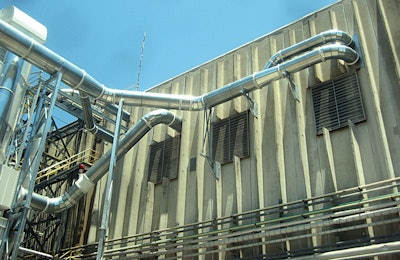
Many dust collection systems, unfortunately, do not provide effective control of dust emissions. This becomes especially serious when combustible dusts and health hazards are involved. Too often, the very systems that are supposed to minimize the risks associated with combustible and health-hazard dusts can create or increase those very hazards. Simply, most of these systems are no more than an expensive mistake that is a constant maintenance headache.
But all of this is totally avoidable. A successful, effective, and low-maintenance dust collection system is achievable. Follow these best practices to reduce long-term costs and maximize your dust collection system:
The method used to determine proper air flow and distribution throughout the system must be the “Balanced-by-Design” method. This is found in the publication Industrial Ventilation, A Manual of Recommended Practice, which is the best single source for properly designed dust collection systems. Too often manual “blast” or “slide” gates are used to attempt to balance the air flows in the system. This almost invariably results in imbalance of the flows throughout the system with too much air flow where it is unwanted and too little in others (leading to accumulations in the ducts, etc.).
Many dust collection systems, unfortunately, do not provide effective control of dust emissions. This becomes especially serious when combustible dusts and health hazards are involved. Too often, the very systems that are supposed to minimize the risks associated with combustible and health-hazard dusts can create or increase those very hazards. Simply, most of these systems are no more than an expensive mistake that is a constant maintenance headache.
But all of this is totally avoidable. A successful, effective, and low-maintenance dust collection system is achievable. Follow these best practices to reduce long-term costs and maximize your dust collection system:
1. Proper system design
The method used to determine proper air flow and distribution throughout the system must be the “Balanced-by-Design” method. This is found in the publication Industrial Ventilation, A Manual of Recommended Practice, which is the best single source for properly designed dust collection systems. Too often manual “blast” or “slide” gates are used to attempt to balance the air flows in the system. This almost invariably results in imbalance of the flows throughout the system with too much air flow where it is unwanted and too little in others (leading to accumulations in the ducts, etc.).
Remember, changing one slide or blast gate changes the flows for all other dust sources. Why not provide a system that inherently, by the laws of physics, ensures proper air distribution at all times without any such adjustments?
2. High velocity
Duct velocities should be kept at a minimum of 4,000 feet/minute when combustible dusts and health hazards are involved. Using lower duct velocities will marginalize the system where even minor upsets or changes will result in accumulations in the ducts which further reduce performance.
3. Contain, capture, control
A successful hood design incorporates all three of the “Cs”: containment, capture and control.
Proper containment of the generated, airborne dusts is the first requirement. The hood configuration should provide for minimizing and controlling the air space where dusts are emitted. But, the containment should also assure that a continuous and adequate air source is available, otherwise the contained dust will accumulate in the enclosure. This accumulation would result in increased hazards that must be avoided or minimized.
Capture involves directing the incoming air flow through the generated dusts to allow capture of the dust. Thus, the mass and velocity of the air flow must be sufficient for this purpose.
Last, the incoming air flow must be sufficient to provide control of the captured dust and convey that dust/air mix into the ducting.
4. Sufficient filter area
Most dust collection systems for the feed industry use either a filter bag or a filter cartridge for separation of the dusts from the air flow. Both types have advantages and disadvantages that should be considered. However, no dust collector will work properly if there is insufficient filter area available.
This is the most common error in main equipment selection and often results from competition among vendors and the desire to minimize costs. Insufficient filter area creates higher energy requirements for the system to function. This causes the fan package to “back up” the performance curve and results in airflows below the minimum required to keep the system functional.
5. Select fan for performance
For most applications, the fan should be located on the “clean” side of the dust collector or cyclone (when there is no filter separation provided). For those systems with a dust collector the fan should have impeller blades either backward curved or inclined to produce the highest efficiency and optimum performance curve. Cyclone-only systems should typically use radial tipped fans for increased efficiency and performance. Material handling, straight-bladed fan impellers should be avoided as they require the most energy and have a flat performance curve. This flat performance curve results in major air flow changes with small changes in energy requirements creating unstable performance.
6. Proper manifolding of the ducting
Using a “plenum” design with multiple ducts stuck into the plenum will result in poor air distribution and accumulations in the plenum, etc. Tapered manifolding that maintains a consistent area cross-section resulting in consistent air velocity will avoid such problems and is a necessity for proper air flow distribution in the system.
7. System performance monitoring
For the typical dust collection system, it is important to monitor the performance of the fan package drive motor, the differential pressure (i.e. energy) across the filters, and the differential pressure at the fan inlet. The fan drive motor amps are directly related to the air-mass flow in the system.
The higher the amps, the more flow and vice versa. The higher the differential pressure, the less the air flow, and vice versa.
8. Proper explosion and propagation protection
Most of the dusts involved in the feed industry are explosive. Mitigation of the potential risk of explosion for the dust collector and the surrounding area is required by the Occupational Safety and Health Administration and the National Fire Protection Association. Isolation of even a mitigated explosion is also required to prevent propagation of the flame front to the dust sources through the ducting system.
9. Invest in quality service, equipment
Hire a competent and experienced engineering/design firm or have qualified in-house experience. Too often the local metal shop or dust collector vendor salesperson is used to “design” the system — with the inevitable poor results.
This up-front cost is necessary to assure the system is designed properly. Make sure they offer training and that the correct equipment is specified, purchased and properly installed.
These best practices comprise just the basics needed, but applying them to your dust collection system will greatly increase the likelihood of successful dust control.