The formation of Akralos Animal Nutrition brought together two of the industry’s most recognizable commercial feed operations: Alltech’s Hubbard and MasterFeeds brands and ADM’s U.S. feed business. The result is a joint venture spanning more than 45 feed mills, 1,200 employees and a combined production capacity in excess of 2 million tons.
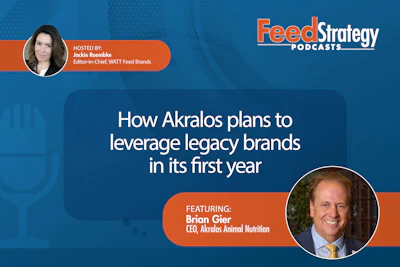
In this episode, Feed Strategy Editor-in-Chief Jackie Roembke sits down with Akralos CEO Brian Gier to unpack what the joint venture means for producers and feed retailers, how Akralos plans to protect and build on the Hubbard and MasterFeeds brand equities, and where the company sees the most growth potential — from grass cattle and dairy beef to lifestyle animal segments.
INTERVIEW WITH BRIAN GIER, CEO, AKRALOS
Jackie Roembke, editor-in-chief, WATT Feed Brands: Hi, everyone. Welcome to Feed Strategy Podcast. I’m your host Jackie Roembke, editor-in-chief of WATT’s feed brands. This edition of Feed Strategy Podcast is brought to you by FeedStrategy.com — your source for the latest news and leading-edge analysis of the global animal feed industry.
Today we’re joined by Brian Gier, CEO of Akralos, the joint venture between ADM and Alltech. Gier is here to outline how Akralos plans to integrate 45 facilities and 1,200 employees under one company while building on nearly 250 combined years of brand equity from Hubbard and MasterFeeds.
Hi, Brian. Thank you again for taking the time to speak with me. Let’s get right into it. Why don’t you tell us a little bit about yourself?
Brian Gier, CEO, Akralos: Thank you for having me, Jackie. My name is Brian Gier, and I’m fortunate to be CEO of Akralos Animal Nutrition. I’ve been in the feed industry my entire working career — it’s an industry that I love. I grew up on a dairy farm in central Missouri that my parents still operate. You could say my entire family is in ag. I actually met my wife showing cows at the Missouri State Fair, and she comes from a farm family as well. I’ve had the opportunity to work in animal nutrition across a lot of different places — I’m on my eighth move — and I’ve really enjoyed the people you get to work with in this industry. That’s the best part, from my perspective.
Roembke: How were you brought in during the creation of Akralos?
Gier: I joined Alltech three years ago working on their overall commercial strategy in the U.S., and I had the opportunity to be part of putting together the joint venture with ADM from the ground floor, which was exciting.
Roembke: ADM and Alltech have had a relationship stretching back to 1980, when ADM was Alltech’s first customer. How does that shared history shape the culture and strategy of Akralos, and what does it mean to formalize that partnership into a single company now?
Gier: As you noted, Alltech and ADM have a rich history. I think that history forms the most important part of this: There is mutual trust and respect between both companies. Whenever you do an acquisition or a joint venture, trust is foundational. Closely following that are shared values — both companies prioritize people and the industry they serve, which aligns and makes this joint venture possible.
Beyond that, what became apparent to me as I came in is that the strengths of each company really complement each other. Alltech brings rich technology and feed additives expertise; ADM brings a world-class supply chain operation. Those strengths complement each other in the commercial feed space, which made this a natural fit.
Roembke: How long were Alltech and ADM exploring the concept of joining forces? When did that dialogue begin?
Gier: From my understanding — I’ve been here three years — initial discussions started back in 2016, and as with any venture of this kind, there can be starts and stops along the way. We were just excited to bring it home this time.
Roembke: Describe the scope of this joint venture for folks who may not be familiar with it.
Gier: The joint venture encompasses Alltech’s commercial feed business in the U.S. — known to consumers as Hubbard — Alltech’s commercial feed business in Canada, known as MasterFeeds, and ADM’s commercial feed business in the U.S. What it does not include is Alltech’s remaining Ridley business, which covers the block and premix operations. This is specifically the commercial feed business of Alltech and ADM in the U.S. and Canada.
Roembke: How many feed mills and employees does that entail?
Gier: More than 40 feed mills — 45 in total — and more than 1,200 employees.
Roembke: What is the production capacity across those 45 facilities?
Gier: Production capacity is in excess of 2 million tons.
Roembke: What are the biggest operational priorities in the near term as you and your team work to integrate those assets and teams under one name?
Gier: As we look at Day 1 priorities, the focus has been on people. We see that as our greatest asset, and we want to make sure we establish the right culture, position people correctly, and provide a framework for continued growth and development. That is priority No. 1.
Closely following is customers. We believe our greatest growth potential remains with our existing customer base, and we want to make sure we continue to take care of them and keep them as partners. Third is operations — ensuring we continue to provide the quality and service our customers are accustomed to.
Roembke: How far into the process are you currently?
Gier: We have been drinking from the fire hose since we closed, but it’s been great. We’ve had a number of plant visits in both the U.S. and Canada, as well as team member and customer visits. The focus keeps coming back to those key priorities: people, customers and our plants.
Roembke: You mentioned the importance of customers. In practical terms, what does this joint venture mean for the producer and the feed retailer?
Gier: We serve a lot of different channels that ultimately get product to farmers and those with backyard animals. For dealers, cooperatives, and farm and ranch stores, our priority is to partner with them in a more meaningful way — forming relationships, delivering customized solutions that help them perform in their marketplace. Not all markets are the same, and we want to help them maximize growth, profitability and their ability to serve their own customers, who are ultimately the farmers.
For farmers directly, it’s the same goal: making sure they get the products they need, the way they want them and helping them maximize productivity.
Roembke: MasterFeeds has significant brand equity in Canada. How does Akralos plan to establish the connection with the parent company identity? What’s the strategy?
Gier: Akralos is the company name, but from our customers’ vantage point, they know us as Hubbard in the U.S. and MasterFeeds in Canada. When our customers see us, they’re going to see Hubbard and MasterFeeds — not Akralos. That is the company name.
We are going to continue to build on the equity of the Hubbard brand, which in two years will be 150 years old, and the MasterFeeds brand, which is 97 years old — nearly 250 years of combined brand equity. As anyone in this industry knows, it is hard to build brands, and we feel fortunate to steward brands that have stood the test of time. We want to continue to put the effort behind them going forward.
Roembke: Since Akralos will be serving both food animals and lifestyle animals, are there segments where you see the most growth potential? Are there species or geographies you’re watching closely?
Gier: You have to start with where you’re strongest. All three companies share strength and growth in commercial livestock — a mature segment in both the U.S. and Canada, but one where all three have had a strong presence. Grass cattle is really in the wheelhouse of all three, and we want to continue to grow and innovate there because we see significant upside.
Following that is commercial dairy — both adult and young animal — and the dairy beef segment, which has grown tremendously and is an area of high focus for us. Closely behind that is the lifestyle segment: equine, backyard flock and show animals.
Geographically, we believe we can effectively service the key markets from our current footprint through Colorado and west, up through Montana. We will continue to look for opportunities to grow our presence in highly dense cow-calf and lifestyle areas.
Roembke: Feed manufacturers globally are navigating those evergreen challenges. With the combined infrastructure, how does Akralos plan to help customers manage them in a way the three separate entities may not have been able to?
Gier: It starts with technology and innovation. Any technology with a positive environmental impact also has to be good for the producer — you can’t just ask producers to adopt it for the sake of sustainability in a tight-margin business. Our focus is on bringing technologies to market that benefit both the environment and animal performance. Both of our parent companies share that mindset, and our belief is that together we can bring those technologies to producers faster than the three entities could separately. We have seen a couple of examples of that over the past two years and are excited to continue building on them.
Roembke: Akralos has been described as an ‘advanced nutrition partner.’ What does that distinction mean to you, and how will you measure whether you’re delivering on it?
Gier: Partnership starts with a win-win situation for our customers. If it isn’t that, it’s not really a partnership. From our standpoint, it’s important to sit down with our customers — with our sales team in the field — ask about their priorities and then map how we can help them meet those priorities. Every market is different, and understanding that is how we help them grow.
Beyond that, we have mechanisms to connect with customers at a national level in both countries. We always lead with: How are we doing, and how can we help them grow? Getting information both locally and nationally gives us insight into what they want and need, so we can customize solutions accordingly.
From a measurement standpoint, there’s both a quantitative and qualitative dimension. Quantitatively, it comes back to growth and profitability for our customers — both matter to their short- and long-term viability. Qualitatively, those listening and insights meetings are key — getting direct feedback on how we’re doing and what we need to do to deepen the partnership.
Over my career, the best ideas we’ve ever implemented have come directly from customers. We’re excited to continue learning from them as we move ahead.
Roembke: Given your extensive history in the industry, what do you think you uniquely bring to this position at Akralos?
Gier: I would point to two things. First, we have a unique product offering. We practice selective distribution — we don’t simply put our product everywhere. We want to place it where dealers and retailers have room to grow and differentiate, without being undercut by the same product in their own market. That differentiation ultimately benefits their customers and supports overall profitability.
Second, when I came into Hubbard, I spent the first six months listening — talking to dealers and customers. The overarching theme was consistent: the product works. Not everything in this business is created equal, and having products that reliably deliver for animal health first, and then productivity, is a key differentiator.
Roembke: Excellent. Is there anything we didn’t touch on that you’d like to discuss?
Gier: Our goal is to be the most trusted name in animal nutrition. I grew up in Missouri — the ‘Show-Me State’ — so it’s been ingrained in me my whole life. We don’t want to tell customers to trust us. We want to show them by doing what we say we’re going to do — and then doing more than that. That’s the culture we’re trying to build: a brand and a company that people know and trust. If our customers are successful, we’ll ultimately be successful too.
Roembke: Thank you so much, Brian, and thanks to everyone for tuning in.