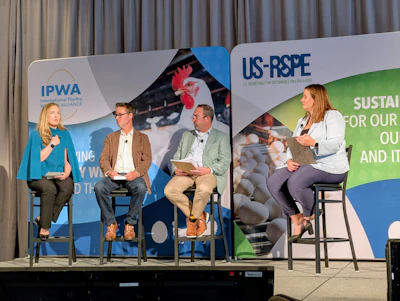
Leaders of three poultry and feed industry organizations said sustainability must be weighed against trade-offs, workforce needs and disease threats during a CEO panel at the 2026 Poultry Sustainability & Welfare Summit on Sept. 22.
The summit was hosted by the U.S. Roundtable for Sustainable Poultry and Eggs and the International Poultry Welfare Alliance. The panelists were Nath Morris, president of USPOULTRY; Megan Provost, chief operating officer of the American Feed Industry Association; and Chad Gregory, president and CEO of United Egg Producers.
Progress by another name
Morris, who has spent 40 years in the poultry industry, said the gains the industry has made over decades amount to sustainability, whatever they were called at the time.
"The progress may have been called something other than sustainability, but it was progress through genetics, through feeding structures, through management, through housing," Morris said. "Everything like that has helped with sustainability."
Words matter
Asked how much the label itself matters, Morris said the language the industry uses shapes how the public sees it.
"Words are important. If you look back on the history of a lot of the processes we go through, we call our broiler plants slaughter plants, we say debeaking chickens, we talk about culling," he said. "Some of the words that we're using create a negative perception."
"We've got to do some repairing of our image to attract more people to come in and work in the industry," Morris said.
Trade-offs and a systems approach
Morris cautioned that changes seen as welfare improvements, such as cage-free housing for layers and slow-growing broilers, can carry environmental costs. Slower growth means poorer feed conversion and more land and housing to produce the same amount of meat, he said.
"Unintended consequences — it's the same as trade-offs," he said. "Whether it's passing laws or changing programs, you've got to think through: If we do this, then what's going to happen? I don't think there's enough thought that goes into that from either politicians or some businesses."
Provost said that is why AFIA views sustainability as a system rather than a checklist.
"I think too often in the sustainability space, outsiders coming in will focus on one piece of that broader puzzle, and I think that really is a disservice to what we're doing as a sector," Provost said. "It's not a collection of individual metrics. It's an overall system that we need to be managing."
She pointed to carbon as an example.
"If you set goals for carbon, you have to think about how that might have some impacts on land use. Maybe it's going to take more acres to do the same kind of work," she said. "Because it is a system, there are going to be trade-offs along the way."
A shifting priority for egg farmers
Gregory, who has been with UEP for 29 years, said sustainability's standing among egg producers rises and falls with customer demands.
"Is it one of the top two or three biggest issues for U.S. egg farmers today? No," he said. "Was it four or five years ago? Yes, it probably was."
"I love the quote from Mike Tyson: Everybody's got a plan until you get punched in the face," Gregory said. "Another saying that I think applies to sustainability is: By the time you need friends, it's too late to make them."
Is sustainability sustainable?
Gregory said he has long questioned whether sustainability is sustainable itself. He cited the Coalition for Sustainable Egg Supply, a two-year research project led by McDonald's and Cargill that compared conventional cage, enriched colony and cage-free housing on commercial farms.
"At the end of those two years, cage-free was the worst of the three systems for the environment," he said. "And yet those same customers that funded that two-year commercial, on-farm study said, 'We're going to go cage-free.' And I couldn't believe it."
Responding to Chavonda Jacobs-Young, former USDA undersecretary and chief scientist, who provided the meeting’s keynote address, who had asked whether farmers can continue to make a living, Gregory offered a different question.
"I think for the U.S. egg industry, maybe the more appropriate question is: Do I want to keep doing this?" he said.
"It isn't just about people, planet and profits," Gregory said. "It's about a lot of things."
He said that is why UEP values the roundtable's diverse membership.
"If UEP were to put together a sustainability platform on our own, we wouldn't include all the different buckets and stakeholders that are in this room," he said. "So, when this becomes a top three issue for the U.S. egg industry again, we will be ready, because we're members of the roundtable."
Gregory said that whatever it is called, sustainability comes down to keeping farms in business.
"All the components that go into a good sustainability program are the exact same components that go into running a business that's successful and can be passed from generation to generation," he said.
PEOPLE AND BIRD FLU
Asked to name the No. 1 issue the industry must get right, Morris said it is people.
"We're down to six poultry science departments in the U.S.," he said. "We've got to find ways to attract people into this industry, and we can't just depend on the six poultry science departments. We need people who understand artificial intelligence. We need robotics engineering, HR folks, communicators to tell our story."
Gregory agreed that workers are important but said the most urgent threat for egg producers is highly pathogenic avian influenza. "We need a vaccine," he said. "The U.S. egg industry needs a vaccine, and we obviously don't want to hurt trade for the chicken industry."
FOOD SECURITY AND RESILIENCY
Gregory said sustainability also extends to food security. He recalled a speaker at a soybean industry meeting 20 years ago who predicted the U.S. might one day ship grain to China and import the resulting meat, eggs and milk.
"If that happens, all they've got to do is just shut the spigot off for a couple of weeks, and we're starving to death," Gregory said. "Sustainability is a big, big conversation."
Provost said supply chain resiliency is the sustainability-related issue drawing the most interest from the feed industry.
"When we're talking about not being able to get some of those key additives, some of those vitamins and amino acids, that has real impacts on animal welfare, on animal health, on food security more broadly," she said.
She said a recent study by the Institute for Feed Education and Research found how dependent the industry is "on a handful of countries, and one country in particular, for our vitamin and amino acid supply."
Despite the challenges, Gregory said poultry is well positioned with consumers who are paying new attention to where their food comes from.
"We've got a great story to tell, and we've got a great product that they want to eat," he said.