
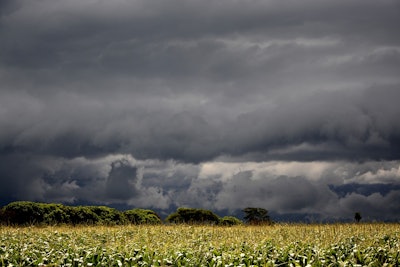
The weekend of April 29 - May 1, 2017 was a strange one for Kansas wheat farmers — mid-spring turned back into winter when a storm dumped between 1 and 20 inches on western Kansas’ already sprouted wheat crop. The extent of the damage to the crop was not known at the time of this writing, according to the K-state Research and Extension Extension Agronomy eUpdate Issue 631, and the full damage may not be known until long after harvest.
No matter how much the snow and cold ultimately damages western Kansas’ wheat, there will be some sort of crop loss, and the damaged wheat will become more susceptible to mycotoxin threats. It represents the new reality of extreme weather events that seem to be on the rise, and it affects every part of the agriculture supply chain.
In the 2008 report to Congress, Weather and Climate Extremes in a Changing Climate Regions of Focus: North America, Hawaii, Caribbean, and U.S. Pacific Islands by the U.S. Climate Change Science Program, now known as the U.S. Global Change Research Program (USGCRP), the current weather landscape is described as such:
The weekend of April 29 - May 1, 2017 was a strange one for Kansas wheat farmers — mid-spring turned back into winter when a storm dumped between 1 and 20 inches on western Kansas’ already sprouted wheat crop. The extent of the damage to the crop was not known at the time of this writing, according to the K-state Research and Extension Extension Agronomy eUpdate Issue 631, and the full damage may not be known until long after harvest.
No matter how much the snow and cold ultimately damages western Kansas’ wheat, there will be some sort of crop loss, and the damaged wheat will become more susceptible to mycotoxin threats. It represents the new reality of extreme weather events that seem to be on the rise, and it affects every part of the agriculture supply chain.
The new normal
In the 2008 report to Congress, Weather and Climate Extremes in a Changing Climate Regions of Focus: North America, Hawaii, Caribbean, and U.S. Pacific Islands by the U.S. Climate Change Science Program, now known as the U.S. Global Change Research Program (USGCRP), the current weather landscape is described as such:
“Many extremes and their associated impacts are now changing. For example, in recent decades most of North America has been experiencing more unusually hot days and nights, fewer unusually cold days and nights, and fewer frost days. Heavy downpours have become more frequent and intense. Droughts are becoming more severe in some regions, though there are no clear trends for North America as a whole. The power and frequency of Atlantic hurricanes have increased substantially in recent decades, though North American mainland land-falling hurricanes do not appear to have increased over the past century. Outside the tropics, storm tracks are shifting northward and the strongest storms are becoming even stronger.”
Regardless of the reasons why, it’s hard to debate that temperatures are rising. The National Oceanic and Atmospheric Administration (NOAA) declared 2016 the warmest year on record. This is the third year in a row, with 11 out of the top 12 hottest years taking place since the turn of the century.
Knowing what to expect from the extreme weather you may have experienced this year is key to running a successful business in agriculture today.
High temperatures and drought
Sweltering summer days and cold winter nights seem like the norm in the Midwest. It may be hard to notice a difference from years past, but according to studies from across the scientific world and based on data compiled by the NOAA, the world is getting warmer. Based on NOAA information, 2016 was 1.69 F above the 20th century average temperature.
Drought and extreme temperatures often go hand-in-hand and both are stressers on crops and land. The drought in the Corn Belt during the 2012 growing season, known as a once in a lifetime drought, caused an estimated $30 billion in damages, most of which was shouldered by the agriculture industry, according to the National Centers for Environmental Information. Even in years where drought is not an issue, research shows that more water is needed in warm years to maintain yields. In the July 19, 2011, edition of farmdoc Daily, Scott Irwin, the Laurence J. Norton chair of agricultural marketing, and Darrel Good, professor emeritus, at the University of Illinois at Urbana-Champaign, calculated that years with higher temperatures in July led to lower corn yields if the amount of moisture in the soil did not increase.
The worst heat waves in U.S. history, according to the EPA, happened during the 1930s, where high temperatures, drought and farming practices lead to the Dust Bowl.
Six mycotoxins
The risks of extreme weather go beyond yield loss to a problem grain elevators and feed manufacturers know well and can protect themselves against — mycotoxins. Facilities in different areas test for different mycotoxins, depending on what is common in their area, but if extreme or unusual weather strikes at the right time in the development of a crop, it can cause mycotoxins outside of the norm to show up.
“Weather plays a significant part in mycotoxin growth,” explains Benjamin Weaver, regional account manager, EnviroLogix. “It can be [brought on by] drought, intense rainfall or heat depending on what stage of growth the plant is in. Pat Frasco, director of sales – milling, grain and pet food, Neogen Corporation, explains it in greater detail.
“There are six major mycotoxins,” said Frasco “Aflatoxin, being the one that is of great concern, is driven by and grows in conditions of drought. So, hot and dry summers are the starting point of aflatoxin concern, primarily in corn. Fumonisin is another that typically is most prevalent in hot but humid conditions. Then you get into the other fusarium molds which would include vomitoxin, zearalenone and T-2. Those toxins tend to thrive in cold and wet conditions. The sixth one is ochratoxin and that tends to be prevalent in a cool and moist environment.”
Warm weather mycotoxins
There are certain types of mycotoxins that thrive in warmer temperatures, depending on the amount of precipitation: aflatoxin during drought and fumonisin with the humidity.
“Abnormal conditions can increase chances of abnormal mycotoxin production,” explained Mark MacBeath, senior manager, product management, BIOO Scientific. “If you have a drought and then you go to wet weather in a short amount of time, that is how fumonisin producing mold grows.”
Of course, the weather is just one of the factors in mycotoxin growth. Other factors play important roles.
“Weather is one of the primary drivers of mycotoxin growth, but frankly, there are many component variables that also come into play,” said Frasco. “Everything from when the crop was planted to agricultural and agronomic practices of rotation, such as no-till, conventional-till, minimum-till effect mycotoxin production. Because a lot of the toxins are soil borne spores, they can winter over year to year and so the concern of a toxin isn’t always limited to a single year. Other stress factors to a crop, whether it be hail damage or insect infestation, are also drivers. Any stress to the crop can have a contributory effect to mold growth and various mycotoxins, but not all stresses necessarily cause mycotoxins.”
Weather can have an effect on crops long after they are harvested. Storage conditions also affect the grain.
“I know a couple years ago when we were sending grain over to Canada on containers, a lot of that wheat and corn in these containers were just sealed up,” said Weaver. “It’s like a sauna in there and it continues to heat up, with aflatoxin and vomitoxin continuing to grow. It might have been low when they loaded it into the containers, but by the time they got overseas or to Canada, it tripled or quadrupled the amount of parts per million of vomitoxin or parts per billion of aflatoxin.”
The world may be getting warmer, but unseasonably cold weather can have an effect on crops as well.
Cold weather mycotoxins
One of the main concerns with the snowstorm in western Kansas does not come from the freezing temperatures. Though the K-state Research and Extension Extension Agronomy eUpdate noted that the low temperatures may have some adverse effects on the wheat depending on the length of exposure, the main concern is whether the snow broke the stalk of the wheat and its state of maturation when it happened.
According to the USGCRP, the frequency and intensity of storms are increasing. The damage caused by storms and flooding can be immense. Winds, rain, snow and hail can damage large areas of crops, while flooding can completely ruin yields. Flooding this year in Arkansas could cost farmers $64.5 million, according to the University of Arkansas System Division of Agriculture.
Cold wet weather also causes vomitoxin to grow, sometimes in crops already damaged by the storms that brought the water and flooding in the first place.
“When there is a lot of vomitoxin or DON in the wheat harvest, it’s usually when we get cool wet weather right around when the plant starts to flower,” said Weaver. “So if we see sustained rainfall and low temperatures, especially overnight and throughout the day in those low 50-, 40- degree days, the plant stays moist and usually tends to see more vomitoxin growth.”
Once more the effects of the weather can linger or even strike after the crop is harvested. MacBeth had a different explanation for the high levels of vomitoxin in the 2016 crop.
“High vomitoxin levels are indirectly related to heavy rains,” said MacBeath. “So if you think about the harvest in 2016, we had a record harvest last year for grain. It far surpassed the capacity to store grain properly. I’ve even heard stories of people driving through the Midwest and seeing mounds of grain covered in tarps. These improvised locations are dark, damp and wet. That’s the perfect condition for mycotoxin growth and in this particular case vomitoxin.”
Be prepared
The boy scout motto “be prepared” translates particularly well to agriculture. Knowledge can help make the best out of a bad situation. Though there is very little a grain elevator or feed manufacturing facility can do about some of the above scenarios, monitoring for mycotoxins when extreme weather hits can limit its effects.
“Abnormal weather or unusual weather is going to cause a very real problem for areas that are unaccustomed to those types of weather events,” explained MacBeath. “If your area does not experience extreme weather conditions very often, when you do get that extreme weather condition, you’re likely going to see an increase in mycotoxins.”