

Learn how optimized phytase dosing with Axtra® PHY GOLD can improve nutrient release, reduce feed costs and maximize feed phytate value in poultry and swine diets.
Brand insights from IFF Animal Nutrition & Health
Feed formulation has always been a balancing act, but today that balance is under more pressure. Prices for protein sources, amino acids and inorganic phosphorus (P) are more volatile, while nutritionists are still expected to protect performance, manage feed cost and make better use of every kilogram of raw material. In this environment, phytase dosing deserves a fresh look. The question is no longer simply whether phytase should be included in swine and poultry diets, but how precisely the dose is being matched to optimalize nutrient release and economic objectives.
What optimized phytase dosing changes in the diet
Phytate (IP6) is the main storage form of P in plant-based raw materials, and monogastric animals have limited ability to use it without the aid of enzymatic addition to feed formulations. An estimated 70% of P content in feedstocks is bound up in Phytate, representing a substantial unavailable nutrient source for livestock.1 Phytate can bind nutrients such as calcium, amino acids and trace minerals, so incomplete phytate breakdown reduces nutrient availability and contributes to antinutritional effects in the digestive tract. Phytase overcomes this limitation, releasing nutrients and increasing their bioavailability for livestock.
Optimized phytase dosing is crucial for maximizing the nutrient potential in feedstocks. A higher phytase dose only creates value when it helps release more usable nutrients from the diet and when those nutrients are captured in the formulation. For feed producers, this turns phytase from a routine additive into a practical tool for optimizing feed cost, nutrient efficiency and raw material variability.
Axtra® PHY GOLD is designed for rapid phytate hydrolysis across a broad pH range, which helps the enzyme act early in the digestive tract where reducing phytate’s antinutritional effects can bring the greatest nutritional return. However, dosing is critical to maximizing these benefits. In a study by Dersjant-Li et al., Axtra® PHY GOLD was evaluated at 0, 500, 1,000, 2,000 and 4,000 FTU/kg in broilers fed diets with varied phytate levels. Increasing the phytase dose from 0 to 4,000 FTU/kg exponentially increased apparent ileal digestibility of IP6 and the sum of IP3-6 up to 100%, an increase of 69 percentage points for IP6 and 78 percentage points for IP3-6 compared with 0 FTU/kg.2
Importantly, the benefit was not just more P release. At 2,000 and 4,000 FTU/kg, IP6 disappearance exceeded 94% across all phytate levels, with minimal accumulation of lower inositol phosphate esters such as IP5, IP4 and IP3. For animal nutritionists, this is important because partially degraded phytate can still have antinutritional effects.
The same research also showed that dietary phytate level influences the response.2 Diets with higher phytate content showed a greater improvement in digestible P, although the optimal dose for maximizing P release may differ depending on substrate availability. That finding is central to practical feed formulation, as optimized dosing should be matched to the diet, not treated as a fixed inclusion level applied in the same way across all formulations.
This phytase dose-response principle is not limited to poultry. Research in piglets also supports the relevance of optimized phytase dosing. In a study reported by Velayudhan et al., increasing phytase dose to 4,000 units/kg feed resulted in IP6 digestibility of 75.6% and cumulative IP3-6 digestibility of 96.4% in diets with a phytate level of 0.24%.3 Together, these findings show that optimized phytase dosing can support more complete phytate degradation in both poultry and swine, while reinforcing the need to consider species, diet composition and phytate substrate level.
Why complete phytate breakdown matters
Phytate breakdown is a stepwise process. As IP6 is hydrolyzed, lower inositol phosphate esters are formed before complete degradation. This is why the disappearance of intact IP6 alone does not tell the full story. What remains in the digestive tract can be just as important as what has disappeared.
Lower IP esters, including IP5, IP4 and IP3, can continue to bind nutrients and contribute to antinutritional effects.4 A diet in which phytate degradation stalls partway through the process may therefore not fully resolve the phytate challenge. Optimized phytase dosing aims to drive the process further, reducing both intact phytate and the accumulation of lower IP esters.
Diet composition shapes the dose response
The value captured from phytase depends on what is in the diet and what those ingredients cost. Phytate levels differ across raw materials, and ingredient availability, by-products, mixed grains, limestone quality, mineral strategy and formulation constraints can all influence the response. For example, phytate levels in broiler feeds can vary from as little as 1.1 g/kg in soybean meal and 1.4 g/kg in corn to as high as 4.8 g/kg in rice bran.4
When prices for protein sources, amino acids and P move quickly, decisions around substrate availability, dose and matrix application become part of day-to-day cost control. As nutritionists work with more diverse raw materials, phytate levels and nutrient availability can become more variable. Optimized phytase dosing provides a way to manage that variability by improving phytate breakdown across different substrates. Trials in mixed-grain diets with reduced available P, calcium and energy have shown that optimized doses of Axtra® PHY GOLD can maintain or improve performance even in more challenging, cost-effective formulations.
This is why optimized dosing should be connected to matrix values. When the phytase dose is aligned with the diet and the amount of phytate present, nutritionists can account for the additional release of P, calcium, amino acids, energy and trace minerals. If that release is not reflected in formulation, the biological benefit may not be fully converted into feed cost savings or performance value.
In practical terms, the goal is not simply to increase phytase inclusion. The goal is to identify the dose and matrix strategy that best fits the diet, the species, the production stage and the economic objective. For example, while the phytate content in corn fed to broilers and laying hens is comparable (1.4 and 1.3 g/kg, respectively), the increase in bioavailable P with 100 FTU phytase addition more than doubles for layers versus broilers (9.7% P increase versus 4.7% P).4 A dose matrix approach that takes these factors into account helps turn phytase from a standard additive into a precision formulation tool.
From P release to broader nutrient value
Phytase has long been associated with P release, but optimized dosing broadens the value proposition. By breaking down phytate more completely, phytase can support improved availability of calcium, amino acids, energy and trace minerals already present in the feed. This makes optimized dosing a practical formulation strategy for capturing more value from the diet through full matrix implementation.
The commercial relevance is clear in performance work. In broiler trials, moving from 1,000 to 2,000 FTU of Axtra® PHY GOLD has been linked with measurable performance and economic value, including improvements in body weight (average improvement of 46.2g in bodyweight), feed conversion and return on investment.2 The size of the response will depend on the diet, production conditions, ingredient costs, phytate substrate level and matrix values, but the direction is important: optimized dosing gives nutritionists another lever to improve the value of the feed.
Similar benefits have been observed in swine (average improvement of 10% bodyweight for piglets and 4.6% for grower/finishers) when higher phytase dosing strategies are compared, including improvements in body weight and feed conversion in piglets and grower/finishers.5 These responses reflect improved utilization of nutrients already present in the diet, rather than the addition of new nutrients.
That lever becomes even more valuable when raw material markets are unsettled. If protein ingredients, synthetic amino acids or inorganic P sources become more expensive or less predictable, releasing more nutrients from the existing feed matrix can help reduce pressure on purchased inputs. With full matrix implementation, optimized phytase dosing can contribute to savings from P and calcium, while also helping nutritionists value amino acids, energy and trace minerals already present in the diet.
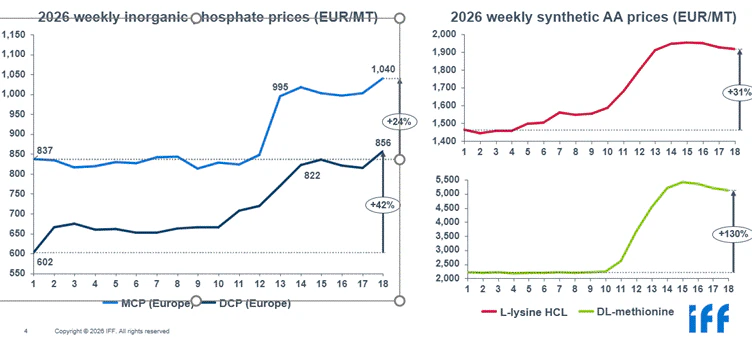
The broader value of optimized phytase dosing is therefore linked to both biology and economics: deeper phytate degradation can support nutrient release, while accurate matrix implementation helps translate that release into formulation flexibility and potential cost savings.
The same logic can also support sustainability goals. By improving P release from plant-based feed ingredients, optimized phytase dosing can reduce reliance on inorganic phosphate and help lower P excretion. This supports better use of finite mineral resources, while also helping producers meet environmental and economic objectives when P sources are costly or variable.
Practical implications for feed formulation
For nutritionists, optimized phytase dosing works best when it is treated as a formulation strategy rather than simply a higher inclusion rate. The process starts with understanding the diet: phytate level, raw material profile, mineral contribution, limestone quality, production stage and performance target. From there, the phytase dose and matrix values can be aligned to capture the nutritional and economic value of more complete phytate breakdown.
A practical starting point is to use 1,000 FTU/kg where appropriate, then evaluate 2,000 FTU/kg or higher based on diet type, phytate substrate level, production goals and current ingredient economics. Body weight, feed conversion ratio, carcass yield, bone mineralization, feed cost savings and return on investment are useful indicators to track. When phosphate, protein source and amino acid prices change, the value of an optimized phytase dose can change as well, making regular reassessment a smart part of formulation practice.
Optimized phytase dosing is not about using more enzyme for its own sake. It is about matching dose to substrate availability, formulation goals and performance metrics, especially when feed costs are under pressure. Used this way, Axtra® PHY GOLD can help nutritionists unlock more value from feed phytate, support more resilient feed strategies and improve the efficiency with which poultry and swine use nutrients already present in the diet.
References
- Dersjant-Li Y, Awati A, Schulze H, Partridge G. Phytase in non-ruminant animal nutrition: A critical review on phytase activities in the gastrointestinal tract and influencing factors. J. Sci. Food Agric. 2015;95:878–896.
- Dersjant-Li Y, Christensen T, Knudsen S, Bello A, Toghyani M, Liu SY, Selle PH, Marchal L. Effect of increasing dose level of a novel consensus bacterial 6-phytase variant on phytate degradation in broilers fed diets containing varied phytate levels. Br Poult Sci. 2022;63:395-405.
- Velayudhan D, Christensen T, Knudsen S, Marchal L, Dersjant-Lia Y, Hans Stein. Effect of a novel consensus bacterial 6-phytase variant on inositol hexa-phosphate degradation profile in growing pigs. Anim-Sc Proc. 2022;13:157–226.
- Dersjant-Li Y, Awati A, Schulze H, Partridge G. Phytase in non-ruminant animal nutrition: a critical review on phytase activities in the gastrointestinal tract and influencing factors. J Sci Food Agric. 2015;95(5):878-96.