

Disconnected data and siloed systems across purchasing, formulation, quality, and production can cause feed purchasing decisions to deliver suboptimal results, despite strong market expertise and sound decision-making by purchasing managers.
Brand insights from BESTMIX Software
Most purchasing managers know how to manage the market. They track price movements, understand supplier dynamics, and make decisions every day that directly affect cost and risk. That expertise has been built over years, and it works. What has changed is the context in which those decisions operate.
A purchasing decision today does more than secure price or volume. It directly influences formulation cost, production planning, margins, and compliance. Still in many feed companies, these impacts are not visible at the moment decisions are made. And this is not a performance issue. It is a visibility issue and issue of using the same data.
In many operations, purchasing, formulation, quality, and production still rely on different datasets and timelines. Purchasing works with contracts and market data, while formulation and planning decisions are often based on delayed or averaged inputs. The result is not a lack of expertise, but decisions being made without the same, current view of the business and by using disconnected tools.
Each function performs well individually. The real challenge is making decisions based on the same, up-to-date information.
This becomes especially relevant when speed is required. A supplier presents an opportunity. The price is attractive; the volume fits. Before committing, you need to understand the broader impact and assess how it affects formulation cost, your current portfolio position, coverage against demand, and how it compares to your average price.
If answering these questions requires time or coordination across teams, the window to act is already narrowing.
At the same time, raw materials are becoming less predictable. Prices shift, specifications vary, and both availability and nutritional values change depending on origin and season. These variations extend beyond purchasing; they affect formulation, production stability, and product quality.
When formulation is not aligned with real contract prices and actual ingredient data, decisions rely on approximations. Not incorrect, but not fully optimized. Over time, that difference becomes measurable.
Across many operations, the same patterns quietly repeat themselves. Formulations are still based on assumed prices instead of actual contract averages. Purchasing decisions are made without clear visibility into their impact on recipes. Contracted volumes don’t fully align with forecasted demand, and ingredient variability is often handled only after intake rather than before decisions are made. Meanwhile, valuable time is lost aligning data across teams instead of acting on it.
None of this stop production. That’s exactly why it persists. But it does affect cost, speed, consistency and over time; it surfaces in reduced margins.
This is where experienced purchasing managers start to feel the limitations. You can secure strong contracts and read the market correctly, but you don’t always have immediate visibility into how those decisions translate across the rest of the business. Decisions are made with partial context, not due to lack of expertise, but because systems and teams are not connected.
The difference becomes clearer when you compare how decisions are made in disconnected versus connected environments:
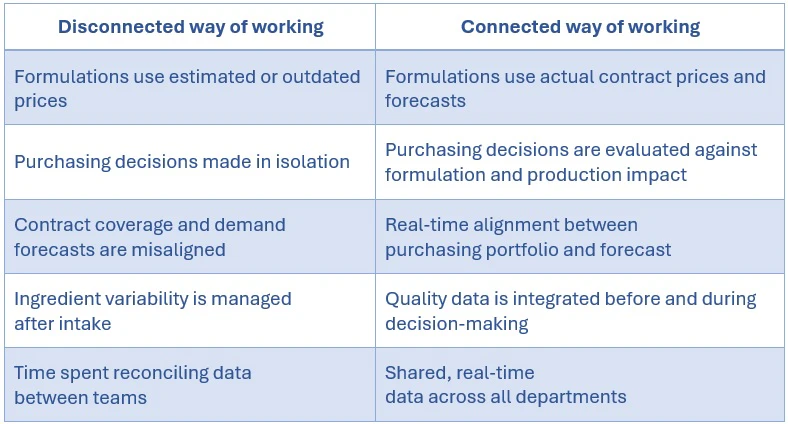
Feed manufacturers who have connected purchasing, formulation, quality, and production into one flow of information operate differently. A purchasing decision is no longer just a price or volume decision. It is immediately understood in terms of its impact on formulation cost, forecast alignment, portfolio exposure, and production implications. There is no need to wait for feedback loops between departments; the information is already aligned and visible.
Raw material variability makes this even more critical. Many companies still rely on safety margins, historical adjustments, or supplier specifications to manage fluctuations in quality. While this provides a level of control, it also introduces inefficiencies to higher formulation costs, inconsistent product output, and increased compliance risk.
When real-time quality data is integrated into formulation, those tradeoffs change. Ingredient matrices reflect actual raw material quality, not assumptions. Recipes adjust accordingly, safety margins can be reduced, and decisions become more precise. No guesses, just informed data-driven decisions.
This is the environment in which solutions like BESTMIX® Software operate. By connecting purchasing data, formulation models, quality control, and ERP systems, they create a shared decision framework across departments.
For purchasing managers, this means the ability to see contract positions alongside forecast coverage, evaluate supplier offers with immediate insight into formulation impact, compare contract prices with the market in real time, and run scenarios before committing - all without relying on manual coordination.
Markets will continue to move, and raw materials will continue to vary. The difference is increasingly defined by how well decisions are connected internally and how quickly the full impact of those decisions becomes visible.
It comes down to how you choose to operate.
You can work with connected tools and integrated solutions that give you full visibility, faster decision-making and the ability to act with confidence as well as reducing daily routine tasks and freeing up time for more strategic work.
Or you can continue managing decisions in a reactive way, piecing together information across teams, and dealing with issues as they arise.
Both approaches rely on your team's expertise, but only one allows you to fully use your team's expertise.